
COMPARISONS · FILM TAPES
Polyimide vs Polyester Tape: Match the Film to the Process and Removal Task
Choose PI or PET from the process and removal conditions, not a film-family ranking.
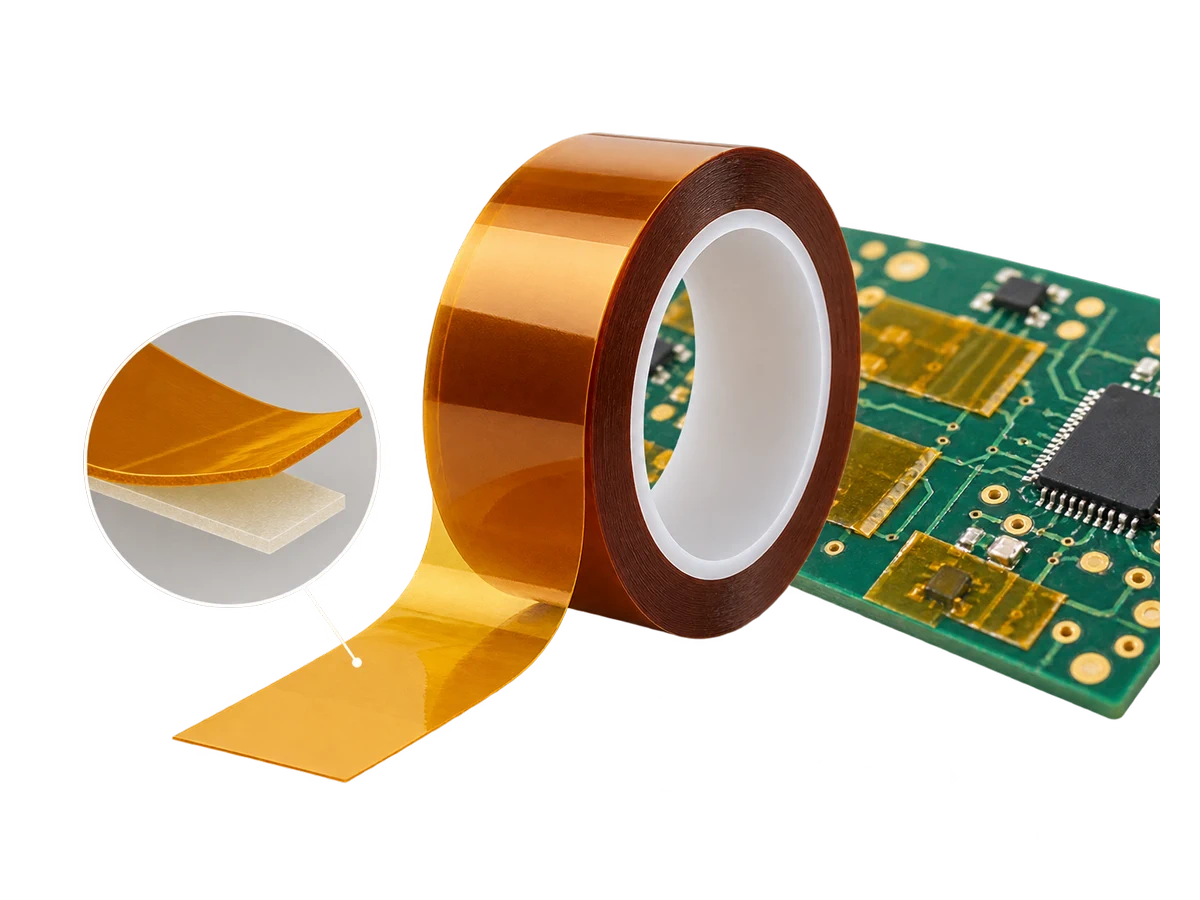
Direct answer: polyimide and polyester tape do not have a universal winner. Choose by the complete backing/adhesive construction and the specific process, then compare exact products on the exposure and removal requirements. A PI tape documented for PCB solder masking and a PET tape documented for powder-coat masking are examples for different jobs; their film labels alone do not establish interchangeability.
Name the process decision before comparing films
Describe what must be masked, the surface under the adhesive, the process cycle and the required removal result. Record peak temperature and duration, ramp and cooling, pressure, chemicals, substrate finish, edge geometry, and when the tape is removed. “High temperature” without dwell and substrate is not a useful selection criterion.
Also identify what failure looks like: lifted mask, resin or paint bleed, adhesive transfer, staining, damaged finish, or a residue that interferes with the next operation. If the application is composite molding, distinguish flash masking and hold-down from mold release or tool protection; these are separate tape functions.
Compare complete tape examples, not polymer names alone
Two 3M products show why selection should be model-specific:
- 3M Polyimide Film Tape 5413 uses a PI backing and silicone adhesive. 3M describes it for protecting residue-sensitive PCB areas during wave soldering or reflow and gives a temperature-use range of −73°C to 260°C. The data sheet defines that range by clean removal from copper and labels its data representative/typical, not specification values.
- 3M Polyester Tape 8992 uses a PET backing and silicone adhesive. 3M lists powder-coat masking, flashbreaker use, and other process applications. Its sheet reports typical backing thickness of 0.052 mm and total thickness of 0.082 mm under ASTM D3652; those are 8992 values, not a generic PET specification.
The two products differ in stated uses as well as film. Do not compare them as though the backing were the only changed variable. Adhesive chemistry, thickness, liner, edge behavior, release and process evidence all belong in the model comparison.
Choose by masking, flash-control and removal conditions
The process itself can reverse an initial PI-versus-PET guess. In composite molding, Saint-Gobain lists both PI and PET product families for flash masking and hold-down. Its selection guide differentiates constructions: CHR K201/K202 are PI/silicone high-temperature options with a stated short-term rating of 310°C for 1–5 hours; PET models include rubber-adhesive, non-silicone options with a stated 200°C short-term rating, alongside separate silicone-adhesive offerings. These are Saint-Gobain-specific products and conditions, not a general ranking of every PI and PET tape. See its flash masking and hold-down selection guide.
That example reveals a decision factor that a film-only comparison misses: in a composite process, silicone contamination may affect subsequent paint or bonding. A lower-temperature non-silicone PET model may therefore be the relevant candidate where contamination control dominates; a named PI model may be shortlisted when the documented temperature range is the controlling constraint. The actual process, product data and downstream acceptance determine the choice.
For a PCB solder mask, 5413 is a more relevant starting example than a PET model whose documentation is centered on powder-coat masking. For powder coating or flash control, use an exact product listed for that process and verify clean removal at the real temperature and surface finish. Do not transfer 5413’s copper removal statement or a Saint-Gobain model’s short-term rating to other constructions.
Identify when the initial shortlist should change
Reopen the comparison when the adhesive chemistry is incompatible with the substrate or contamination rules, the dwell exceeds the model’s stated exposure, removal occurs at a different temperature, or the part geometry needs a linered form. A converted die-cut also adds release, orientation and edge-lift questions that a roll test may not answer.
The initial shortlist should change if its model-specific evidence does not cover the full process. That does not prove the opposite film family will work: it means compare another exact construction or revise the masking route. A color, marketplace description or “PI/PET” label cannot close the evidence gap.
BROADYA’s polyimide engineering guide and PET tape page describe adjacent material families. They are useful starting points for a product discussion, not evidence that an unspecified Broadya model matches 5413 or 8992.
Qualify the exact tape on the actual process
Run a representative sample on the production substrate and finish. Apply the tape with the intended pressure and edge geometry, run the complete heating/chemical cycle, cool as in production, and remove at the actual process step. Record edge lift, creep, masking line, residue, surface damage and any downstream effect. Define pass criteria before testing and retain the exact model, lot, document revision and process profile.
Frequently asked questions
Is polyimide tape always more heat resistant than polyester tape?
No universal ranking follows from film names. Compare exact product, adhesive, exposure duration, substrate and removal conditions.
Can a PET tape replace PI tape for solder masking?
Only if an exact PET model is documented for the board process and passes the full representative cycle and removal criteria.
Why can adhesive chemistry matter more than film choice?
The adhesive contacts the work surface and can affect hold, residue and downstream contamination. The film name does not identify those behaviors.
Next step
Share the process profile, substrate finish, mask geometry, removal step and contamination/residue limits. Use the high-temperature PI application guide for the separate application-specific PI topic; this page compares film families through actual process decisions.
Discuss your application
Tell us the substrate, the joint and the service conditions. We reply with what fits and what does not.