
ENGINEERING GUIDE · POLYIMIDE TAPE
Polyimide Tape: An Engineering Guide to Construction, Temperature and Insulation
Choose a polyimide tape construction by its actual role and exposure profile, then qualify the complete tape rather than relying on film data alone.
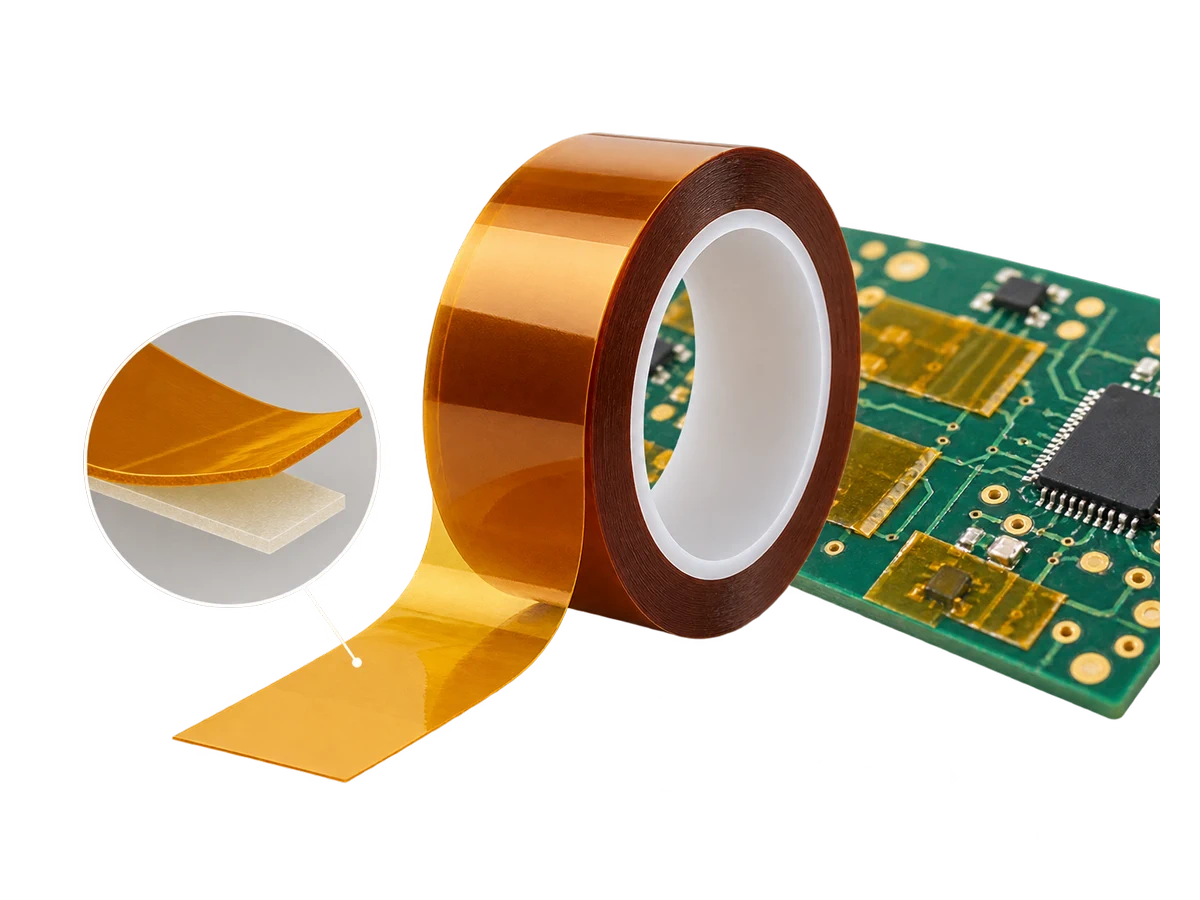
Start with the intended role and exposure profile, then specify the film, adhesive, total construction and test evidence together. A tape qualified for temporary solder masking is not automatically suitable for long-term insulation or load-bearing attachment.
Key takeaways
- Choose the tape by temporary masking, installed insulation or attachment duty; these are different qualification tasks.
- Specify the complete construction and its substrate, temperature–time profile and removal or service-life requirement.
- Published product ratings are model-specific. The 3M 5413 example is not a BROADYA rating.
- BROADYA confirms general polyimide tape supply; confirm the offered construction and supporting documents for the project.
Polyimide tape is often selected because the film can remain dimensionally useful during demanding thermal processes. The engineering decision, however, concerns the whole tape: polyimide backing, adhesive, coating weight, liner where applicable, and the way that construction behaves on the actual substrate. For example, 3M 5413 is a specific polyimide-film/silicone-adhesive tape documented for PCB masking. Its published properties describe that product; they do not establish a universal polyimide-tape rating or a BROADYA specification.
First decide whether the tape is temporary or permanent
A removable process mask has a different success criterion from an installed insulation layer. For masking, the engineer wants the tape to remain in place through the process, protect a defined area, then peel away without unacceptable residue or damage. For installed insulation, the tape must retain the required electrical and mechanical function after the full operating exposure. For permanent attachment, the adhesive must sustain the relevant load on the chosen substrates. A material that performs one of these tasks may fail another.
This distinction changes the shortlist immediately. If the tape is removed after wave soldering or powder coating, investigate a product whose supplier documents that process and its dwell time. If the tape remains in an electrical assembly, request dielectric and ageing evidence on the finished construction. If it carries a sustained structural load, a polyimide masking tape should not be assumed to replace a double-sided bonding tape.
Specify the exposure as a temperature–time profile
“High temperature” is incomplete. Record the peak temperature, time at peak, number of cycles, atmosphere, contact with chemicals and whether removal occurs hot or after cooling. The adhesive may become the limiting component even when the film remains intact. The published tesa 51408 data, for example, describe a particular polyimide/silicone product and its stated thermal properties. The corresponding figure must not be copied into an RFQ as a generic rating for all polyimide tapes.
A useful RFQ separates process survival from service life: “Mask this area during a specified heating cycle and remove cleanly” is a different qualification from “remain installed for years at elevated temperature.” For either case, test the exact tape and actual surface; film heat resistance alone cannot answer adhesive residue, peel force or long-term retention.
As a product-specific example, the 3M 5413 technical data sheet lists a use range up to 260 °C and defines that upper condition around clean removal from copper. The same sheet lists typical backing thickness as 0.03 mm and total tape thickness as 0.07 mm, and labels its technical data representative or typical rather than specification values. These are 3M 5413 details under its stated conditions, not generic polyimide-tape limits or BROADYA ratings.
Treat electrical insulation as a finished-construction requirement
Published dielectric data are construction- and test-specific. The 3M 5413 technical data sheet, for example, identifies the tape construction and its stated test method; those values apply to 3M 5413 only. For another tape, define the required method and acceptance condition for the finished tape or wrapped assembly. Do not infer a voltage rating from film appearance or the word “polyimide.”
If a purchaser asks for a particular insulation class, flame classification or certification, request the actual document for the offered construction and its scope. A cited competitor product with such a classification does not confer it on another tape.
The construction fields that change a purchase decision
An actionable comparison sheet names the backing grade and thickness, adhesive chemistry, total thickness, liner and roll format. It also identifies which side contacts which substrate, whether the tape is removed, and how failure will be judged. For temporary masking, compare edge definition, holding during the process and residue after removal. For electrical insulation, compare finished-assembly breakdown/creepage requirements and ageing. For die-cut parts, include tolerances and whether the tape must be handled by a machine or by hand.
This is more informative than a single headline temperature. Two products with similar film thickness can behave differently because their adhesive systems, exposure limits and removal requirements differ.
What to send with a polyimide tape inquiry
State the application, whether removal is required, substrate, maximum and sustained temperatures with dwell time, electrical or chemical exposure, target thickness, part dimensions, roll or die-cut format and the test report or standard your project requires. This lets a supplier identify a candidate construction and disclose which requirements it can document. BROADYA has confirmed that it supplies polyimide tape. The exact available construction, converting format and documented performance must still be matched to the application before purchase; no grade-specific rating is asserted here. See the BROADYA Polyimide Tape category and request the datasheet for the proposed construction.
For a process-specific route, read High-Temperature Polyimide Tape: Five Application Checks. For a joint that must carry load rather than serve as a mask or insulation layer, the foam tape selection guide addresses a different decision.
Inquiry next step: Send the process temperature–time profile and the acceptance test. Ask for a construction-specific response rather than assuming a generic polyimide rating.
Frequently asked questions
Does a polyimide film temperature rating equal the rating of the finished tape?
No. The adhesive, total construction, exposure duration and test method can change the usable limit. Use documentation for the exact finished tape and process.
Can a polyimide masking tape also be used as permanent electrical insulation?
Not automatically. Temporary masking and installed insulation have different acceptance criteria. Qualify the finished construction in the intended assembly and service conditions.
What should I include in a polyimide tape RFQ?
Specify the substrate, process or service role, temperature and dwell profile, removal requirement, electrical or chemical exposure, dimensions, format and required test evidence.
Discuss a polyimide tape application
Share the process, substrate, exposure profile and acceptance test. The team can confirm which construction and documentation are available for your project.