
APPLICATIONS · POLYIMIDE TAPE
High-Temperature Polyimide Tape: Five Process Applications and Their Qualification Checks
Evaluate five process uses for removable polyimide tape by the conditions that determine whether the mask works and comes off cleanly.
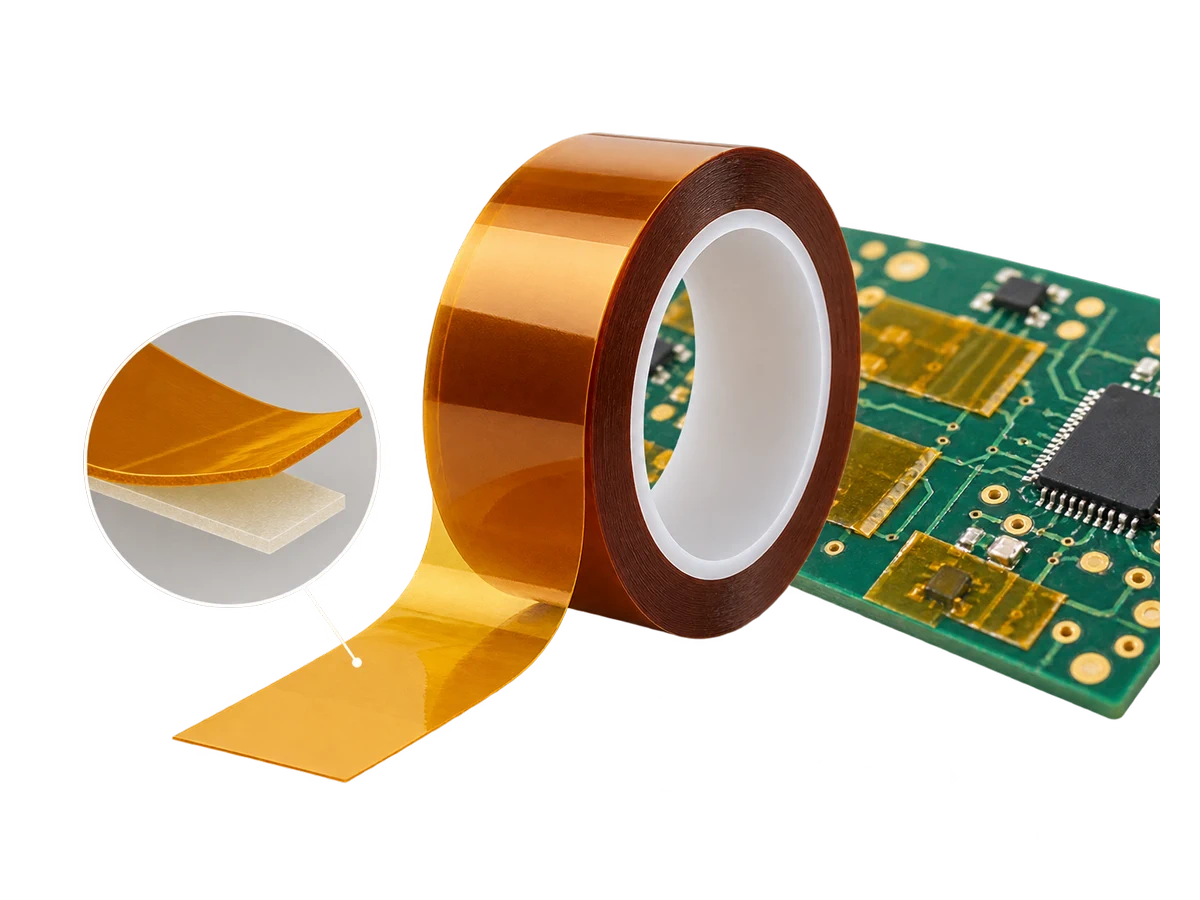
Consider removable polyimide tape only for a defined masking, protection or temporary handling task whose complete tape construction is documented for the process. Check peak temperature, dwell, cycles, adhesion during the step, and residue or damage after removal. Do not transfer one vendor’s rating to another tape.
Key takeaways
- Polyimide tape is worth evaluating only against a defined process task and actual exposure profile.
- Check temperature, dwell, cycles, substrate, adhesion during the step and residue or damage after removal.
- The 3M 5413 example reports up to 260 °C under a product-specific clean-removal condition; it does not establish another supplier’s rating.
- BROADYA confirms general polyimide tape supply; confirm the offered construction and supporting documents for the project.
Polyimide film can be useful where ordinary masking materials lose dimensional stability, but the film is only one part of a pressure-sensitive tape. 3M 5413 and tesa 51408 are documented examples of polyimide film with silicone adhesive for certain high-temperature processes. Their published values belong to those exact products. This article is an application screening guide, not a BROADYA product rating.
For scale, the 3M 5413 technical data sheet lists a use range up to 260 °C and ties the stated upper condition to clean removal from copper. That condition applies to 3M 5413 as documented; it is not a universal polyimide-tape service rating and does not specify BROADYA tape.
1. PCB contact and solder masking
A removable mask can protect selected board areas during wave soldering or solder dip. The engineer should map the protected area and check whether the tape holds its edge throughout flux, heat and removal. 3M identifies PCB gold-finger masking during wave solder or solder dip as an application for 5413. That is a reason to research a comparable construction, not proof that every polyimide tape will perform equally.
The qualification sample should use the actual board finish and process profile. Inspect for edge lift, solder intrusion, adhesive transfer and damage after removal. If the tape remains in the assembly rather than being removed, the decision becomes an installed-material qualification and belongs in the construction and insulation guide.
2. Powder-coating masks
Masking a threaded hole, contact face or colour boundary through a coating oven demands two outcomes: the mask survives the oven and comes off with an acceptable edge and residue level. tesa lists powder coating among the applications of its 51408 product. The actual choice still depends on the coating chemistry, oven profile, masked geometry and removal timing.
Specify whether a sharp paint edge or removal from a delicate surface is the harder condition. A tape can withstand heat yet leave residue, tear during removal or disturb the coating edge. Qualify these separately rather than treating temperature alone as pass/fail.
3. Temporary protection during heated fabrication
A film surface can protect a part or provide a release interface during a heat-cure or fabrication step. 3M describes a release-surface use for 5413 in elevated-temperature fabrication. Define precisely what contacts the tape: resin, tooling, metal or another surface. Chemical compatibility and the required release behaviour may be more restrictive than the temperature.
Test under the same contact pressure and duration as production. A laboratory peel after a short heat exposure may not predict residue after a longer cycle or multiple cycles. Do not call a tape a permanent protective layer when it is qualified only as a removable process aid.
4. Electrical assembly masking and temporary isolation
The manufacturing team may need to keep a region isolated while winding, coating or assembling an electrical component. Here the tape may be a temporary mask, a handling aid, or part of the finished insulation system. These are distinct roles. For a temporary role, check process retention and clean removal. For a permanent role, define the finished assembly’s dielectric, ageing and mechanical requirements and obtain scope-matched test evidence.
tesa reports electrical properties and an insulation class for its 51408 construction. Those statements cannot be copied to an unspecified tape. The 3M 5413 technical data sheet likewise reports data for a named construction and test basis; those values do not certify another supplier’s tape or a complete assembly.
5. Chemical-process masking
Polyimide/silicone tapes are also marketed for selected chemical production processes. The first filter is the actual chemical, concentration, contact time and temperature. An adhesive that tolerates a dry oven may not tolerate a wet chemical bath or leave an acceptable surface after removal. tesa includes chemical production processes in the application fields of 51408, but that broad label does not qualify a different formulation for a particular reagent.
Run a small-scale compatibility test on the real part. Record swelling, edge penetration, adhesive transfer and surface change after the full process and cleaning sequence. A process team should reject a candidate if it protects the film but contaminates the final product.
How to specify the test rather than a generic temperature claim
For all five applications, send the process sequence, peak and dwell temperatures, number of cycles, substrate, chemical exposure, masking geometry, removal point and residue acceptance criterion. Ask for a construction-specific data sheet and sample. “260 °C service” and “Class H” are not generic properties of polyimide tape; the values visible in named manufacturers’ documents apply only to their named constructions and stated conditions. BROADYA has confirmed that it supplies polyimide tape. This guide does not assign a temperature or electrical rating to the supplied family: the exact construction and evidence must be checked for the specific process before a purchasing commitment. See the BROADYA Polyimide Tape category and request documentation for the proposed construction.
Frequently asked questions
Is all polyimide tape suitable for high-temperature use?
No. A polyimide backing does not establish the temperature limit of the adhesive tape. Check the finished construction against the full temperature, dwell and cycle profile.
What is the best application for high-temperature polyimide tape?
There is no universal best application. Removable masking may be worth evaluating for a defined process when the supplier documents the exact tape for that exposure and removal condition.
Does a competitor’s temperature rating apply to BROADYA tape?
No. Published ratings apply to the named manufacturer’s construction and test conditions. Ask for evidence that names the exact proposed product.
Discuss a polyimide tape application
Share the process, substrate, exposure profile and acceptance test. The team can confirm which construction and documentation are available for your project.