
APPLICATION GUIDE · INDUSTRIAL DOUBLE-SIDED TAPE
Automotive Double-Sided Tape: Match the Construction to the Assembly
A practical selection path for automotive tape, from substrate finishes and trim geometry to OEM validation.
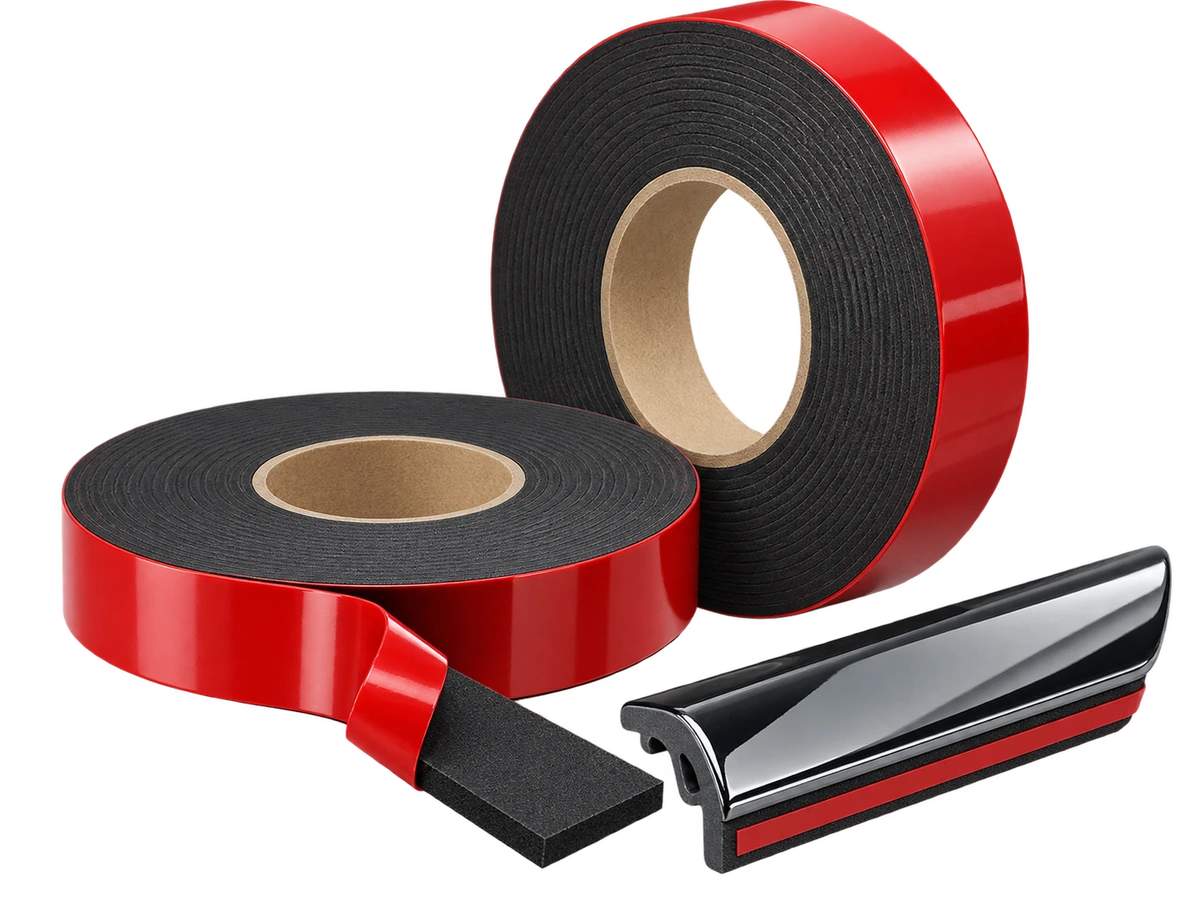
Automotive double sided tape for an OEM assembly should be shortlisted by substrate pair, bondline geometry, load and service exposure; the word automotive alone cannot qualify a trim, badge or interior joint.
How to choose automotive double-sided tape for an OEM assembly
A useful automotive tape brief names the part, both substrates, the finish on each side, the overlap area and how loads reach the bond. “Automotive” is a market label, not a performance specification. A badge on a curved body panel, a wheel-arch molding and a low-profile interior clip are different joints.
Start with both bonding surfaces
BROADYA lists acrylic foam tape for automotive exterior trim and metal, glass and plastic bonding. That catalog statement identifies a relevant family; it does not qualify every grade for every paint system or trim polymer. The acrylic foam product page asks buyers to match the model to the application and validate a sample.
For exterior trim, consider contour, bondline thickness, thermal movement, water exposure and the paint/trim surfaces. The existing wheel-arch trim design article focuses on the geometry and load path of that specific joint. For badges, the car-emblem tape guide is the narrower owner. For interiors, emissions and odor questions belong with the VOC and fogging evidence guide.
How joint geometry and service load affect the bond
A production trial should use the actual paint, molded polymer, cleaner, application pressure and dwell. 3M’s VHB surface-preparation guidance emphasizes substrate-specific preparation and evaluation of the selected tape/process. Its guidance applies to its VHB products; it does not set a BROADYA specification. Record the process window and inspect the failure mode instead of relying on a generic “high bond” description.
Paint, coated metal, textured plastic and low-surface-energy trim do not present the same bonding surface. Identify the actual finish and any release agent, plasticizer or coating before choosing a tape.
A rigid lap, curved trim, gap, edge-loaded tab and vibration-exposed attachment place different demands on the bondline. Map the load and movement before comparing thickness or headline tack.
Separate candidate screening from qualification
See the related wheel-arch trim joint design for the narrower application details.
See the related PE foam tape for car badges and emblems for the narrower application details.
How to test automotive double-sided tape on production parts
See the related automotive interior tape VOC and fogging checks for the narrower application details.
For an automotive tape review, send the part, both substrate finishes, bond area, service exposure and assembly process so the candidate construction can be scoped.
The first useful engineering artifact is a joint description, not a product name. Identify the component, the exact paint or coating on the body side, the polymer or finish on the trim side, the nominal bond area, and the way the part is loaded during service. Include curvature, gaps, edge exposure and whether the trim can flex independently of the panel. A small change in surface finish or molded texture can make a previously successful sample irrelevant, so identify production-representative lots rather than generic material names. If the part is already assembled, document how the operator places and presses it; hand pressure on a bench coupon may not represent the line method.
Read the failure location
Separate the screening question from qualification. Screening asks which tape family and bondline deserve a trial. Qualification asks whether a specific model, on specific surfaces and after a defined process, meets the program’s acceptance criteria. BROADYA’s acrylic-foam range is presented for automotive exterior trim and bonding metal, glass and plastics, which makes it a sensible family to investigate for some assemblies. The page does not certify every grade against every automotive paint, plastic, or OEM requirement. Treat the catalog match as a starting point and confirm the precise model, current technical documentation and sample before making a design commitment.
Plan the trial around the failure that would matter. For trim, inspect whether separation occurs at the tape-to-surface interface, within a coating, or through deformation of the carrier or part. Check the edges and corners as well as the center: a joint may look sound across its face while a peel front begins at a lifted edge. Record surface preparation, application pressure, dwell and conditioning so that a pass can be reproduced. 3M’s VHB preparation guidance is useful as a process reference for 3M systems, but its specified steps and results do not transfer automatically to a BROADYA construction.
What an automotive tape RFQ should specify
A sourcing handoff should therefore include a drawing or clear part description, both substrate finishes, bond area, service environment, assembly sequence, production volume and required customer tests. If any of those are unknown, mark them as open inputs rather than filling them with a generic automotive assumption. This distinction prevents a broad search phrase from being mistaken for an approved material specification and helps the supplier return a candidate that can be evaluated on the real joint.
When comparing two candidate builds, hold the assembly constant and change one meaningful variable at a time. If both the tape model and surface preparation change together, the result will not tell the engineer which change mattered. Keep a record of the sample lot, cut dimensions, application direction and conditioning sequence. Where a molded component has several possible contact zones, mark the intended area on the drawing; otherwise a trial may bond to an unusually smooth region that is not representative of production. The purpose is not to create a universal automotive recipe, but to narrow the construction for this part and this process.
The design review should also include manufacturing and service stakeholders. A material that can be bonded in a laboratory may be difficult to place repeatably at line speed or to inspect after assembly. Ask how operators will locate the part, remove the liner, control the placement window and detect a misaligned bond. If rework is possible, document whether a misplaced component can be lifted without damaging the paint or whether the assembly must be scrapped. These process constraints can change the preferred format or joint geometry even when the underlying tape family remains appropriate.
A final design review should distinguish requirements that are fixed by the customer from preferences that can still change. Mark mandated tests, prohibited materials, approved suppliers and appearance constraints separately from assumptions about service life or process conditions. If the buyer cannot yet provide a requirement, record who will resolve it and by when. This keeps an exploratory sample from being mistaken for customer approval. When the assembly reaches production, transfer the approved construction and process window into the controlled specification so that the purchasing description, work instruction and quality plan refer to the same configuration.
Frequently asked questions
Can one automotive double-sided tape grade bond every trim material?
No. A grade that works on one paint, coating or trim polymer is not automatically qualified for another finish. Confirm the actual surface pair and test representative production parts against the OEM requirement.
Should automotive tape be chosen mainly by thickness?
No. Thickness is only one construction variable. Joint gap, curvature, edge loading, substrate movement and process pressure all affect whether a candidate is appropriate; compare complete constructions on the intended joint.
What should an automotive tape RFQ include?
Include the part drawing, both substrate finishes, bond area, service environment, assembly method, annual volume and required validation tests. Identify customer-mandated requirements separately from assumptions still awaiting confirmation.
Discuss this tape application
Share the substrates, joint geometry, process and service conditions so the team can scope an appropriate tape construction.