
SELECTION GUIDES · AUTOMOTIVE INTERIOR
Low-Odor Tape for Automotive Interiors: Check VOC and Fogging Separately
Screen interior tape evidence against separate odor, VOC and fogging requirements.
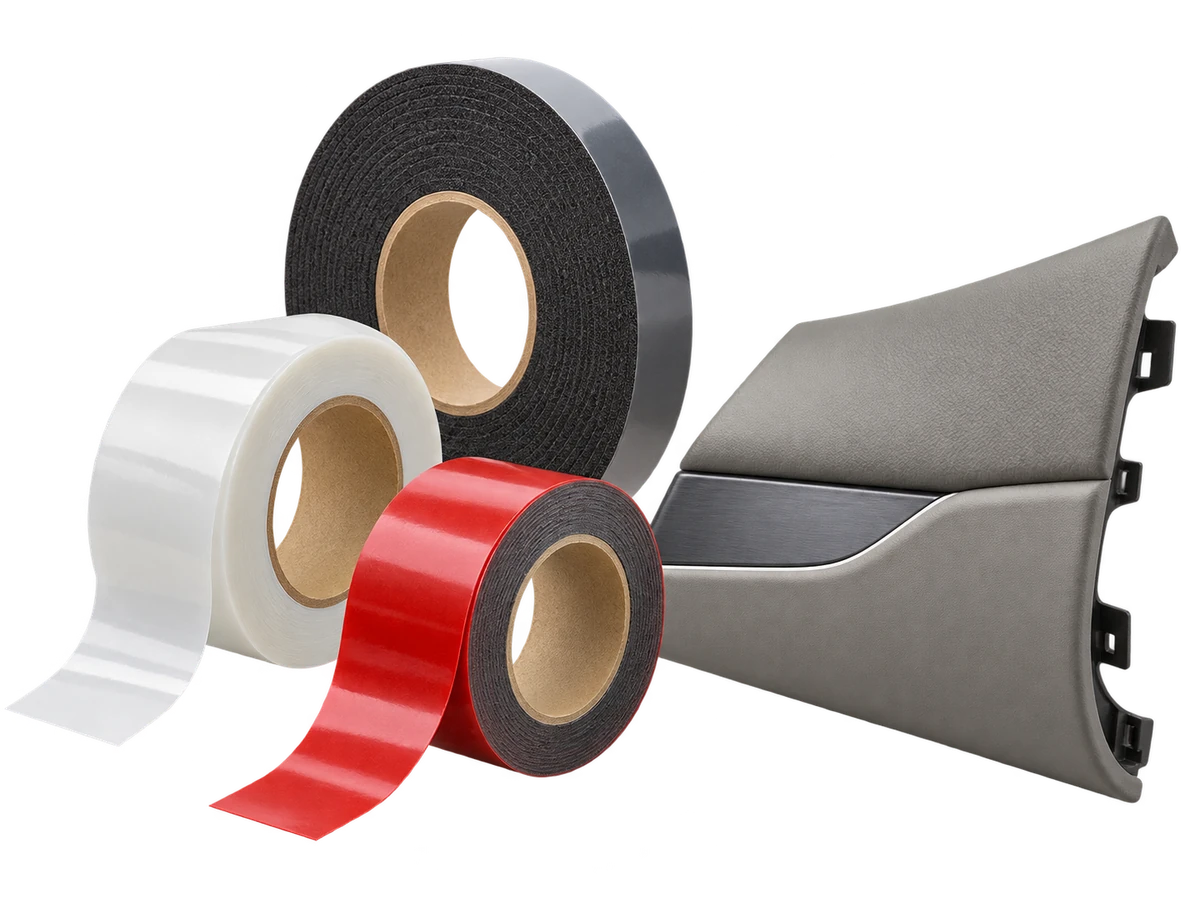
Treat odor, VOC and fogging as separate measured requirements. Match each candidate report to the OEM method, limits, specimen construction and conditioning; a low-odor marketing label or another maker’s product data cannot qualify a Broadya tape.
Three claims require three answers
An odor panel result addresses perception under its specified conditions. VOC analysis addresses named emitted compounds or totals under a test protocol. Fogging measures material deposition on a surface under another protocol. They are related screening topics, but one low-odor statement is not a pass for the others. 3M’s low-VOC product information lists VDA 270, VDA 278, VDA 275 and SAE J1756 as different methods. The existence of those reports for a 3M model says nothing about a Broadya model unless that model has its own scoped result.
Make the evidence comparable before selecting a tape
Compare the named method and revision, specimen and layer stack, conditioning, units, detection limits and OEM acceptance threshold. A 3M model report is evidence for that model only.
Ask whether the reported specimen was raw adhesive, the full tape, or a bonded trim assembly. Check the conditioning and whether the OEM wants an initial or aged result. A report with no model identity, test date, method revision or acceptance limit cannot close a material-approval decision. A 3M model TDS illustrates why: even a fogging value is tied to a method and dwell condition. Its numbers cannot be carried over to another construction.
Decide when the assembled part governs
When the OEM protocol evaluates the finished assembly, adhesive, carrier, foam, substrate and process residues can contribute to the measured result, so the component-level test governs.
For example, a foam pad, molded resin, cleaning residue and tape may all be present in the tested interior component. It is an engineering inference that a single-layer result cannot prove the complete stack; the applicable OEM protocol decides which specimen is accepted. The buyer should also check bond performance after the required heat and humidity cycles, since emissions suitability does not prove adhesion suitability.
The low-VOC tissue tape product page is a product-family starting point, not a compliance certificate.
Turn the OEM requirement into an evidence decision
Start with the customer specification. Extract the method and revision, acceptance limit, specimen, conditioning and whether the criterion applies to a tape component or the assembled trim. Then map each requirement to its own result. 3M’s product information lists VDA 270 for odor, VDA 278 for VOC and fogging emissions, VDA 275 for formaldehyde, and SAE J1756 for fogging characteristics. Confirm the current method and limit in the customer-controlled requirement; the method names are not interchangeable labels.
| Evidence requested | What it answers | What it cannot prove alone |
|---|---|---|
| Odor result under the specified method | Whether the tested specimen met that odor criterion under its procedure | VOC totals, formaldehyde or fogging |
| VOC/emissions result, such as the specified VDA 278 route | Which emissions were evaluated and whether reported limits were met | Odor acceptance or fogging unless separately tested |
| Fogging result under the OEM method | Whether the tested specimen met that deposition criterion | General “low odor” or every emissions requirement |
| Formaldehyde result, when required | The named formaldehyde criterion for that specimen | Other VOCs or the complete assembly |
Treat each report as a scoped record. It should identify the exact model and construction, method revision, specimen, conditioning, result units and acceptance limit. If a field needed to compare with the OEM requirement is missing, hold for clarification. A “low VOC” phrase can help find candidates but does not satisfy a named threshold.
Decide which specimen governs
A component report answers a component question. If the OEM method calls for the final bonded assembly, a result for adhesive or tape alone cannot qualify that stack. The specimen may include the tape, trim resin, paint, cleaner residue and other materials. The customer method determines specimen preparation and acceptance. Do not predict which layer dominates without evidence.
Confirm with the materials or quality owner whether approval is component-based or assembly-based before commissioning a test. If the specimen is unclear, stop the approval decision; a technically correct report can still answer the wrong question. If the exact construction has no result for the required method, it remains an unqualified candidate. Another manufacturer’s test cannot be transferred.
Keep emissions approval separate from bond approval
A passing emissions result does not establish adhesion after heat, humidity, vibration or aging. Track separate criteria against the same named assembly and candidate. The Low-VOC tissue tape family page is an inquiry route, not a compliance certificate. The cited 3M reports belong to their named 3M constructions and do not establish Broadya results.
Next step
Send the OEM method and limit, part construction and specimen conditioning. Request scoped test evidence for the exact candidate; no certification is implied here.
Discuss this application
Share the substrate, joint or drawing, service conditions and the decision you need to make.