
APPLICATION GUIDE · APPLIANCE PANEL BONDING
PE vs EVA Foam Tape for Appliance Panels: What Changes the Choice?
For appliance panel and trim mounting, Broadya’s current catalog makes PE the clearer first sample direction; EVA remains a candidate for genuinely light-load cushioning. Neither family page proves exact-grade performance.
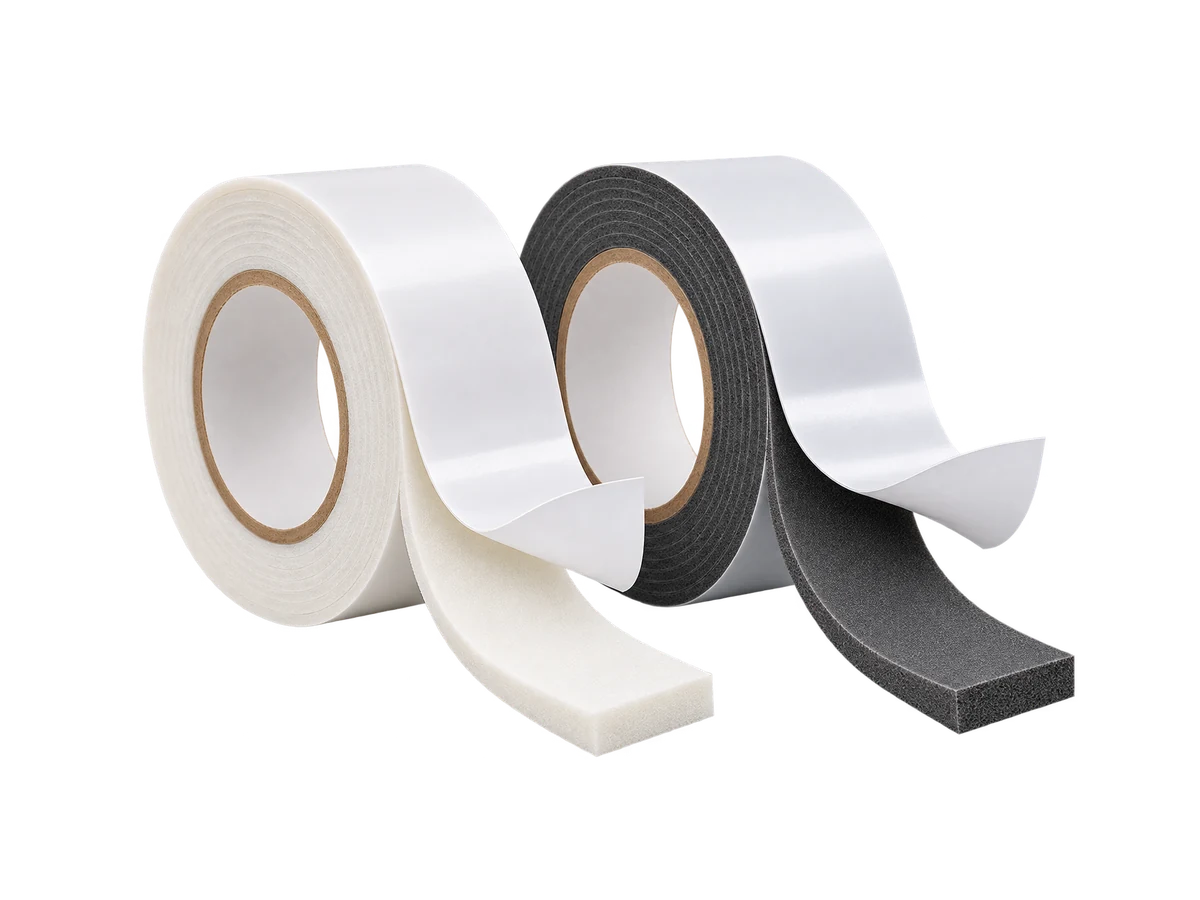
For a double-sided foam tape used to mount an appliance panel, overlay or decorative trim, PE is the clearer first sample direction in Broadya’s current catalog. Broadya’s PE foam tape for appliance panel mounting page names fridge/freezer panels, control overlays and decorative strips, and lists a 0.5–3.0 mm thickness family with an adhesion figure of at least 18 N/25 mm. Its EVA page instead positions standard EVA foam for cushioning and light-load fixing, with a 0.5–3.1 mm family range. This is a catalog-based screening decision, not a matched PE-versus-EVA performance test. If the duty is light-load cushioning, EVA may remain relevant; the exact grade must meet the joint requirements.
Why PE is the first sample direction for panel mounting
The distinction comes from the current application evidence, not a universal claim about polymer strength. Broadya lists appliance panel mounting as a PE use case and describes mounting fridge/freezer panels, control overlays and decorative strips. The public page also lists acrylic adhesive, -20 to 120 °C reference temperature range, 0.5–3.0 mm thickness and adhesion of at least 18 N/25 mm. Treat these as the current public family-page statements; verify exact-grade data and test method before putting a value on a drawing or specification.
Avery Dennison independently lists polyethylene foam tapes among common appliance tape constructions and says selection depends on substrate, operating environment and application. tesa also lists PE foam for appliance trim, emblem and display applications; that is tesa family context, not Broadya performance evidence.
Start with the Broadya PE foam tape family when the duty is panel, overlay or trim mounting and the actual joint and exposure fit the grade data. Do not read “PE” alone as a performance guarantee.
Where EVA fits—and where the public evidence stops
Broadya currently describes its standard EVA foam tape around cushioning, shock absorption and light-load fixing. The family page lists acrylic adhesive and 0.5–3.1 mm thickness, and describes a soft closed-cell core. That makes EVA a reasonable candidate to evaluate when the appliance part is light, the bond is not carrying a demanding sustained load, and cushioning is part of the task.
The reviewed public EVA page does not provide a directly comparable adhesion value or a matched panel-mount test against the listed PE family. Therefore the evidence does not establish that PE is always stronger, that EVA is always softer under a defined method, or that either one will pass a particular appliance requirement. See the Broadya EVA foam tape family for its current public scope.
Joint conditions that can change the choice
Before ordering samples, record the two substrates and their coatings, the panel gap and flatness, tape width and bond area, load direction, service temperature, humidity or cleaning-fluid exposure, and assembly pressure and dwell time. These constraints can disqualify a candidate even when its family-level description sounds suitable. Avery Dennison’s appliance guidance likewise makes substrate, operating environment and application central selection factors.
Thickness ranges are not interchangeable performance evidence. Broadya’s PE family lists 0.5–3.0 mm while its EVA family lists 0.5–3.1 mm. Measure the real joint and tolerance, then request the exact grade and tolerance. Do not infer compressibility, compression set, peel strength or shear life from nominal thickness.
If your main concern is gap and shear rather than appliance duty, compare the decision with our PE foam tape thickness and gap-fill guide; that page addresses thickness and shear selection broadly, while this page is about the first family to screen for appliance panel mounting.
How to qualify the exact grade on an appliance panel
- Use production-representative panel materials, coatings and surface preparation.
- Set the intended tape thickness, width, overlap and application pressure; control dwell and conditioning.
- Test the load mode that matches the design—such as peel at an exposed edge or shear under sustained panel load—using a documented method and agreed acceptance criteria.
- Condition samples for the actual temperature, humidity, vibration or cleaning exposure; inspect for edge lift, movement and visible bond-line change.
- Approve a specific product code and revision. Requalify changes to foam, adhesive, liner, dimensions or manufacturing source that can affect the bond.
Use PE as the first candidate for the panel/overlay/trim duty described on Broadya’s PE family page. Add EVA when the part is genuinely light-load and cushioning-led, or when the measured assembly shows it meets the same acceptance criteria. This is the evidence-supported boundary of the current catalog comparison.
What engineering and procurement should specify
Engineering should define substrate and finish, bond geometry, gap range, load direction, service exposure, test setup and pass criteria. Procurement should quote the exact grade or controlled construction, thickness and tolerance, adhesive, liner, width/shape, color, packaging and lot/change controls—not just “PE foam tape” or “EVA foam tape.”
For a sample review, send a panel drawing or photos, both substrate finishes, target dimensions, operating conditions, annual volume and the acceptance test. Broadya’s catalog pages are family-level information; application-specific capability remains to be demonstrated on representative samples.
Sources and limits
- Avery Dennison appliance tape guidance — appliance construction examples and selection factors.
- tesa PE foam tape overview — PE foam application context; tesa-specific performance claims are not transferred here.
Frequently asked questions
Should I sample PE or EVA foam tape first for an appliance panel?
For panel, overlay or decorative-trim mounting, Broadya’s current PE page is the clearer first sample direction because it names those appliance uses. Consider EVA where the part is light-load and cushioning-led. Test the exact grade on representative panels.
Does the listed PE adhesion value prove it will hold my appliance panel?
No. The public PE page lists at least 18 N/25 mm, but a value without the exact grade, method, substrate and conditioning does not qualify your joint. Confirm the applicable test data and validate the design assembly.
Are PE and EVA foam tape thickness ranges directly comparable?
The public family ranges overlap—0.5–3.0 mm for PE and 0.5–3.1 mm for EVA—but nominal thickness does not establish compression, bond strength or fit. Match the exact grade and tolerance to the measured joint.
Review your appliance panel tape application
Send the panel materials and coatings, joint drawing or gap range, service conditions, target dimensions and annual volume. The review can identify relevant grades for sample evaluation; performance must be verified on your assembly.