
BUYER'S GUIDE · PET DOUBLE-SIDED TAPE
How can production buyers build a useful PET tape sample-validation plan?
A PET tape sample trial is useful only when it represents the intended parts and production process. The supplied catalogue lists PET double-sided tape in several thicknesses and liner formats, but a catalogue description cannot answer every application question.
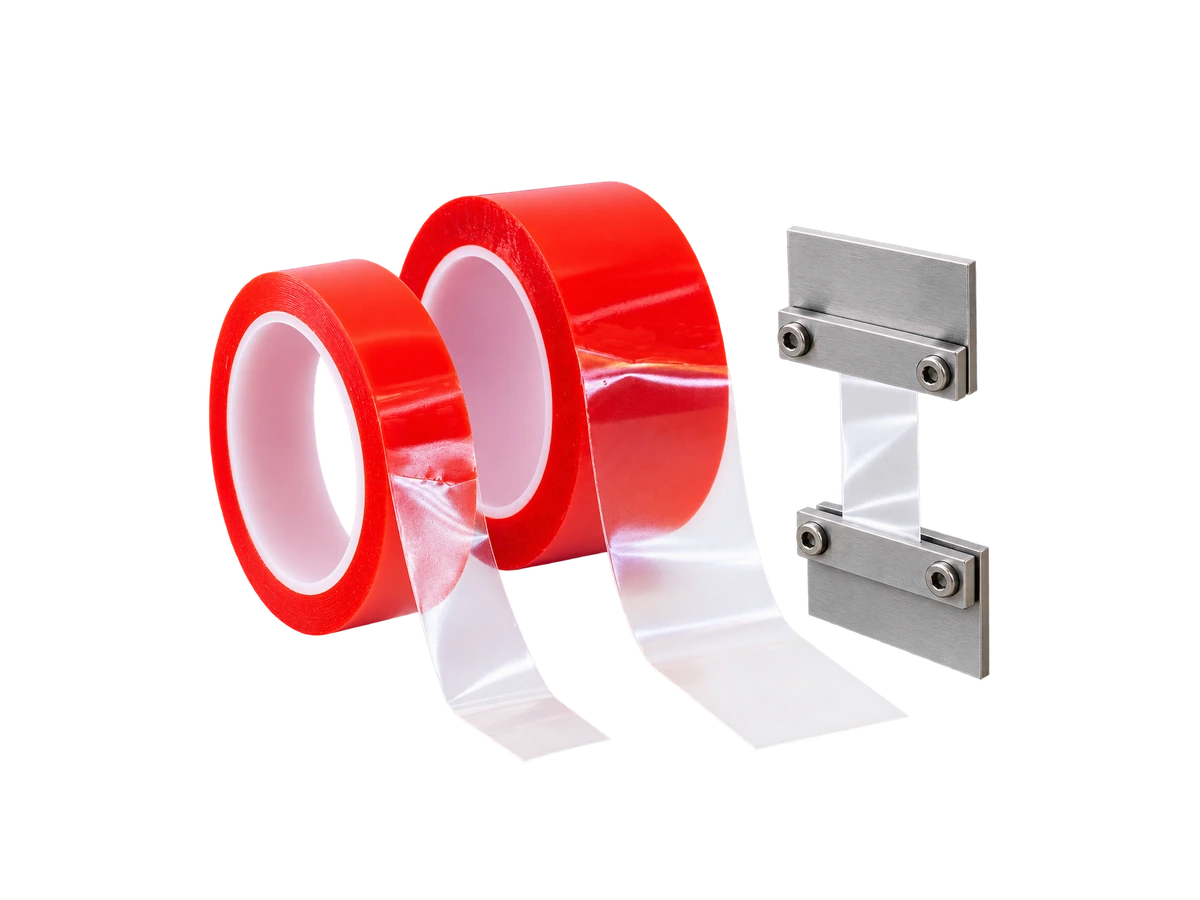
A PET tape sample trial is useful only when it represents the intended parts and production process. The supplied catalogue lists PET double-sided tape in several thicknesses and liner formats, but a catalogue description cannot answer every application question. Buyers can reduce guesswork by defining what the trial must prove, controlling the application steps, and documenting the result. For broader model and specification context, read the PET Tape: Specs, Uses & Selection.
State the decision the trial must support
Before requesting samples, write down the decision: for example, whether a candidate can proceed to a pilot build, whether the converted part fits the line, or whether more engineering evidence is needed. Avoid vague objectives such as “check if it works.” A clear objective determines the materials, measurements, and acceptance criteria.
Identify the exact component pair and revision. Record substrate grade, surface finish, coating, bond area, part curvature, edge exposure, and any visible region. If the part is not yet finalized, mark the sample result as preliminary and identify what could change.
Request traceable sample constructions
The PET catalogue lists a 30–205 micron range and models at 30, 50, 80, 100, 125, 160, and 205 microns. It also lists white paper, MOPP red film, and yellow grid paper liners. Ask the supplier to identify the exact model, thickness, liner, roll or die-cut format, and product revision for every sample. For current constructions and listed applications, see the Double Sided PET Tape product page.
Do not compare unidentified pieces or samples that differ in multiple ways without recording those differences. If several candidates are needed, use a sample matrix that shows which factor changes between them. Request the documents applicable to each construction, and keep general catalogue material separate from test evidence.
Use the PET tape selection guide and the published mobile-frame and battery assembly example to frame the application, then document the exact sample construction and acceptance criteria for your own parts.
Match the production application steps
Write the planned preparation and application method: cleaning, drying, liner removal, placement, pressure, tool or roller, dwell, assembly sequence, and time before handling. State the operator or equipment used and record any deviations. A sample applied by hand may not represent a high-speed or fixture-based production line.
If converting is involved, test the intended slit width or die-cut shape. Check registration, liner release, part handling, waste removal, and edge quality. Confirm roll core, winding direction, and outside diameter if the production equipment depends on them.
Define inspection points and acceptance criteria
Inspect at planned stages: immediately after application, after assembly, after the required dwell, and after conditioning. Possible observations include placement offset, bubbles, wrinkles, adhesive squeeze-out, edge lift, movement, residue, visible appearance, and liner handling. Choose only the measurements that matter to the application.
Write pass/fail criteria before the test starts and use the project’s approved limits. If the test is exploratory and no limit exists yet, label the outcome as observational rather than approved. Record instrument, environment, sample count, and any uncertainty so another reviewer can understand the result.
Record failure mode, not only pass or fail
When a sample does not meet the criterion, note where the separation or defect occurred and what the part looked like before failure. Distinguish tape-to-substrate separation from substrate damage, cohesive adhesive behavior, liner problems, or a geometric issue. This helps route the next action to the right owner: product selection, surface preparation, converting, assembly process, or part design.
Change one variable at a time when practical. If model, surface preparation, bond width, and pressure all change together, the next result cannot identify which change mattered.
Keep evidence and approval traceable
The final record should include sample IDs, product model, lot or revision if available, substrate and part revisions, process settings, test method, result, deviations, reviewer, and approval status. Link reports to the exact construction tested. A RoHS record, for example, addresses a compliance question; it does not replace a bond-performance trial.
If the supplier claims a property such as temperature capability or high transparency, ask for the test method, sample construction, and applicability to the product under review. Keep unsupported or unverified claims out of a released specification.
A compact trial request
Send the drawing, materials, bond geometry, candidate thicknesses, liner and conversion needs, line process, sample quantity, inspection plan, environmental conditions, acceptance criteria, and required documents. Ask the supplier to identify what is confirmed and what remains a test question.
This structure makes a sample program reviewable and repeatable. It also prevents a successful demonstration on one surface or process from being generalized to a different part without evidence.
Make the validation report actionable
A useful report includes the question, tested construction, sample identification, method, observations, deviations, conclusion, and remaining risk. State whether the result is a screening result, pilot approval, or production qualification; these statuses should not be used interchangeably. Include the responsible reviewer and the date the decision was made.
When a test is inconclusive, state what additional evidence is needed and who owns the next step. Examples include confirming a report’s scope, repeating the trial with a production substrate, measuring a converted dimension, or agreeing on an acceptance threshold. An explicit open item is more valuable than a vague “pending” label because it lets the team close the gap.
Do not generalize one successful sample to every application named in a product catalogue. Keep the approved-use statement tied to the part, revision, process, and conditions represented by the test. With those details ready, Request a PET tape quote or sample.
Discuss your PET tape application
Share the substrate pair, bond-line dimensions, assembly conditions and target volume so our team can review a suitable PET tape construction and sample format.