
BUYER'S GUIDE · PET DOUBLE-SIDED TAPE
How should buyers evaluate PET double-sided tape for mobile frames and battery compartments?
PET double-sided tape can be considered for mobile-device frame, battery-compartment, battery-board, and related component assembly when the joint is thin and the parts need a converted adhesive format. The catalogue lists these as application areas and describes a PET film carrier with oil-based adhesive.
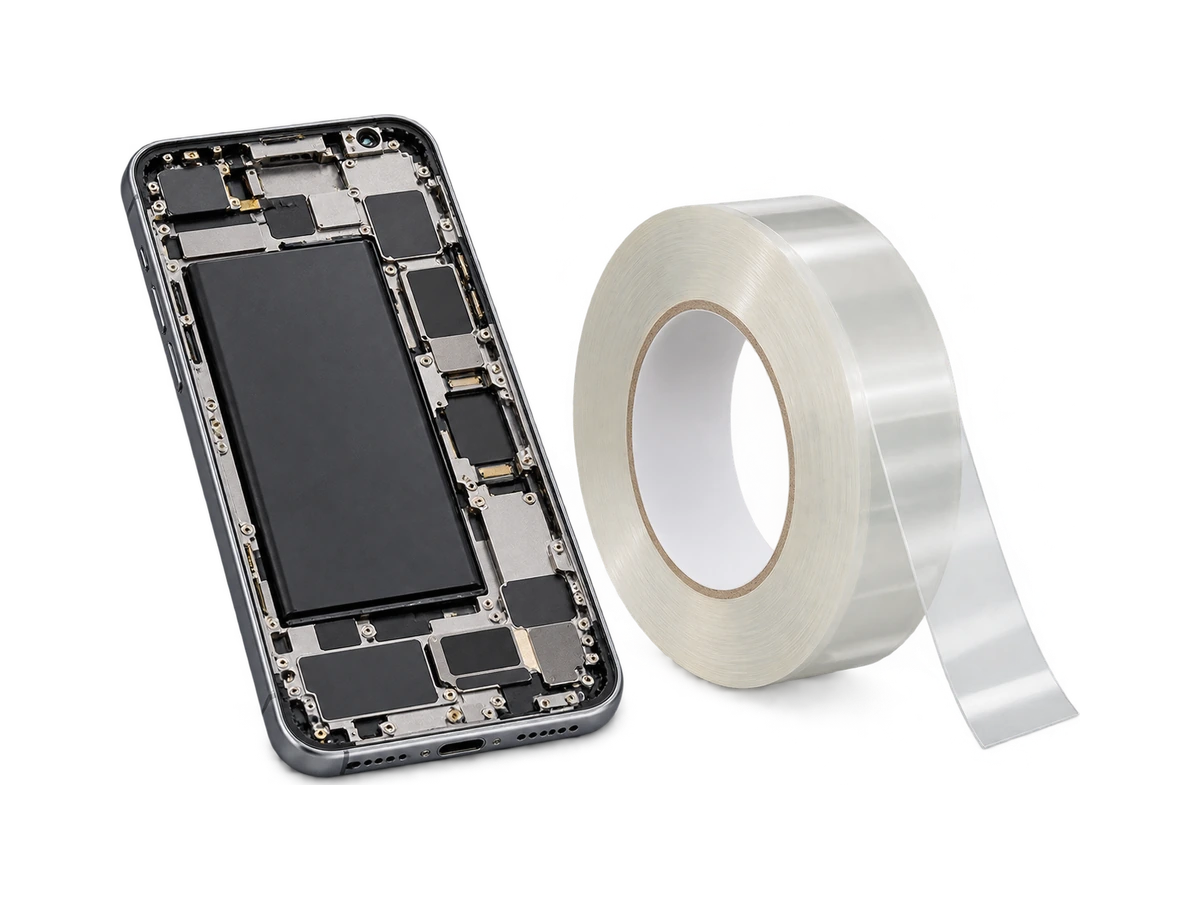
PET double-sided tape can be considered for mobile-device frame, battery-compartment, battery-board, and related component assembly when the joint is thin and the parts need a converted adhesive format. The catalogue lists these as application areas and describes a PET film carrier with oil-based adhesive. That makes it a reasonable starting point for a supplier discussion, but it does not prove that a particular tape will work in a specific phone or device design. Buyers should define the joint, surfaces, assembly process, and acceptance test before selecting a model.
Map the actual joint before choosing a tape
“Mobile assembly” can describe several different interfaces: a frame-to-housing joint, a battery-compartment component, a battery board, a display window, or a small internal part. These joints do not necessarily share the same surface finish, bond width, tolerance, exposure, or service requirement. Start with a drawing or sample that identifies both adherends and shows the bond line. Record whether either surface is painted, coated, textured, flexible, or treated with a release agent.
Also identify the function of the bond. Is the tape positioning a part during assembly, joining two components for service life, or securing a component whose movement could affect fit? The answer changes the required validation. Do not translate a general product application list into a device-level reliability claim.
Treat thickness as a stack-up variable
The supplied PET catalogue lists seven models from 30 to 205 microns: BY6983G (30 μm), BY6972G (50 μm), BY6980G (80 μm), BY6982G (100 μm), BY6928G (125 μm), BY6967G (160 μm), and BY6965G (205 μm). Buyers can use this range to frame a sample request. The thinnest option is not automatically best for a precise assembly, and a thicker option does not automatically solve gaps or surface variation. For current constructions and listed applications, see the Double Sided PET Tape product page. For broader model and specification context, read the PET Tape: Specs, Uses & Selection.
Compare the tape thickness with the available stack-up, part flatness, tolerance accumulation, and required edge position. If the design uses a narrow bond band, show the actual width and keep-out zones. Ask the supplier to identify the proposed construction and explain what still needs to be validated on the finished part.
Plan liner handling around the assembly line
The catalogue lists white paper, MOPP red film, and yellow grid paper liners. For a small device part, liner selection affects handling, registration, and removal sequence. Describe whether operators apply tape by hand, use a fixture, pick a die-cut piece, or run an automated placement process. Confirm the peel direction and whether the liner needs visual marks or enough stiffness to stay flat during placement.
Request a converted sample that matches the intended part geometry. A hand-cut strip may not represent how a production die-cut part behaves at corners, narrow tabs, or small holes. Inspect whether parts stay on the liner during handling and release cleanly during placement.
Check the complete assembly, not only the tape roll
Before approving a candidate, build representative assemblies with the actual frame and housing materials. Use the planned cleaning method, pressure, fixture, dwell, and assembly order. Record initial placement, edge alignment, bubbles, wrinkles, liner removal, exposed adhesive, and any movement during subsequent handling.
Set the conditioning plan from the device’s intended use and internal qualification requirements. After conditioning, inspect edge lift, displacement, adhesive transfer, cosmetic marks, and the actual failure location. If the result is unacceptable, change one variable at a time—for example, thickness, bond width, surface preparation, or application pressure—so that the next trial has a clear purpose.
Keep documentation claims in scope
The catalogue includes a RoHS statement for PET tape. If compliance documentation is required, ask for the applicable report and confirm that the report covers the exact product construction under review. A catalogue statement should not be treated as proof for every converted part, supplier lot, or regulatory requirement without checking document scope.
Likewise, a listed application or catalogue property does not establish a device service-life result. Keep documented product information, engineering hypotheses, and test results in separate fields in the approval record.
Buyer information to send with a sample request
Provide the component drawing, substrate pair, surface finish, bond-line dimensions, thickness target, liner preference, converted-part geometry, annual volume, application equipment, assembly pressure, dwell, and qualification criteria. Include photographs of the interface and identify any cosmetic or electrical keep-out regions. Ask the supplier to label each answer as documented, proposed, or pending validation.
This preparation helps the supplier recommend a PET candidate without assuming that a general device application is already approved. The final decision should be based on a representative assembly and a documented acceptance plan. With those details ready, Request a PET tape quote or sample.
Discuss your PET tape application
Share the substrate pair, bond-line dimensions, assembly conditions and target volume so our team can review a suitable PET tape construction and sample format.