
APPLICATION GUIDE · FLAME RETARDANCY VERIFICATION
Flame Retardant Double Sided Tape: How to Verify a UL94 Claim
Which UL 94 protocol actually applies to a thin tape, why an FMVSS 302 pass is a different result, what the flame rating leaves uncovered inside a battery pack, and the four documents to demand before you shortlist a supplier.
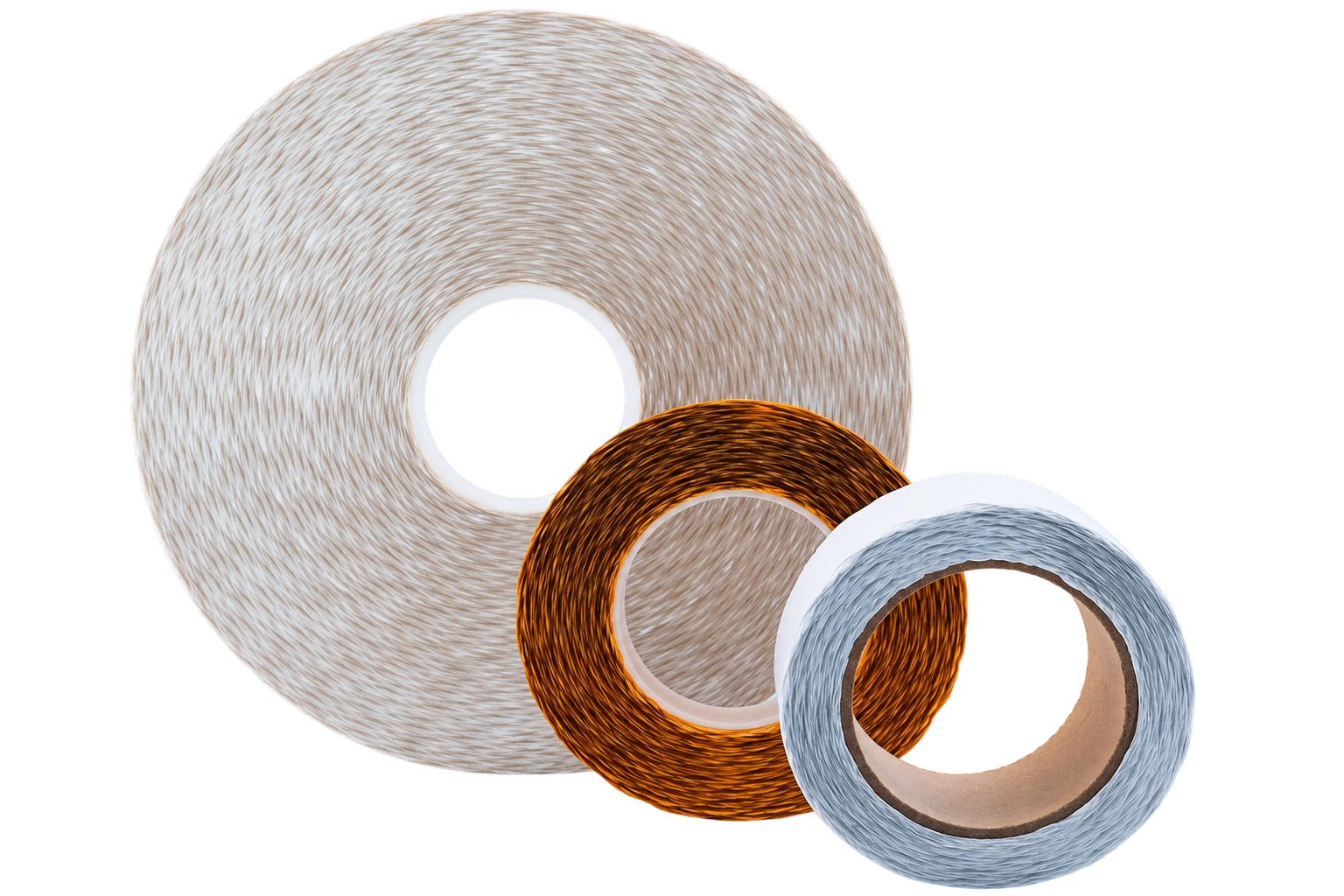
Four things need checking, and they are separate checks. Which UL 94 rating was actually run on a construction as thin as the tape you are buying. Whether the FMVSS 302 result came from the same construction. What the flame rating does not cover once the tape is inside a battery pack. And whether the supplier will release the test report behind the claim, or only a catalogue bullet.
Most specification failures on flame-retardant tape do not come from a bad product. They come from a rating that was earned on a different specimen than the one being purchased.
Which UL 94 rating applies to the tape you are buying
UL 94 does not have one vertical burn test. It has a test for rigid bars and a separate test for thin flexible materials, and the two produce different ratings that are not interchangeable.
V-0 is assessed on rigid plastic specimens, typically thicker than 0.41 mm, clamped vertically in a fixture.
VTM-0 is the Vertical Thin Material protocol. It is assessed on flexible specimens thinner than 0.25 mm, suspended freely rather than clamped.
Double-sided tape sits in the second category. A 100 to 140 µm flame-retardant tissue tape is well under the 0.25 mm threshold, so the applicable question is not “does it meet V-0” but “was the VTM protocol run, on this thickness”. Both ratings require the same observable behaviour — after-flame under 10 seconds, no flaming drips, no ignition of the cotton indicator below the specimen — but they are measured on different geometry, so a V-0 figure cannot be transferred to a thin tape.
There is a second distinction that matters more in practice. The rating belongs to the whole construction, not to the film. Base film, adhesive, and where present the release liner are burned as a laminate. A supplier who quotes a rating earned on the carrier film alone has not rated the tape.
A practical example of how this is documented correctly: a fluoropolymer tape maker lists VTM-0 for 0.05 to 0.19 mm and V-0 for 0.2 to 1.0 mm in the same datasheet, with the UL file number published alongside. That format tells a buyer exactly which protocol applies to which thickness.
Why an FMVSS 302 pass is not a UL 94 rating
The two standards answer different questions, and passing one says very little about the other.
FMVSS 302, at 49 CFR 571.302, is a horizontal burn test for materials in vehicle occupant compartments. The specimen is 102 mm wide by 356 mm long at the thickness used in the vehicle, clamped between U-shaped frames and conditioned for 24 hours at 21 °C and 50 percent relative humidity. A specified flame is applied for 15 seconds and then removed.
The pass criteria are stated in the regulation as either of two outcomes: the material does not burn or does not transmit a flame front across its surface at more than 102 mm per minute, or it stops burning within 60 seconds of the timing start without having burned more than 51 mm from that point.
UL 94 is a vertical test with a cotton ignition indicator and a drip requirement. FMVSS 302 is horizontal, has no cotton indicator, and is scored as a rate. A construction can pass one and fail the other, because the flame is attacking a different face in a different orientation.
This matters for a battery pack because the requirement set often names both. If a specification says “FMVSS 302 compliant” and the supplier answers with a UL 94 V-0 certificate, no one has answered the question. Ask which standard, which edition, and on which construction.
What the flame rating does not cover inside a battery pack
Flame retardancy is one axis of a module requirement set, and it is not the axis that usually fails first.
A flame rating is silent on the thermal path. If the tape is expected to move heat from a cell surface toward a cooling plate or heat spreader, the burn behaviour tells you nothing about that, and the filler package that raises thermal conductivity can itself change the burn result.
It is silent on dielectric withstand. A tape used between a busbar and a module wall needs a breakdown voltage figure for that construction at that thickness, which is a separate measurement from the flame test.
It is silent on compression behaviour. Module clamping applies sustained load, and a foam or thick tissue construction that performs well in a burn test can still take a compression set that loosens the joint.
It is silent on ageing. Flame packages can migrate or degrade under sustained heat and humidity. A rating earned on a fresh sample does not describe a part after 1,000 hours at 85 °C and 85 percent relative humidity, and that is the state the module will be in for most of its service life.
The practical consequence is that a flame-retardant tape selected only on burn performance can pass the material review and still block the module approval on one of the other four points. The requirement set should name all of them, and the supplier should be asked for each separately.
The four documents to demand before you shortlist
A flame claim that arrives as a catalogue bullet is not evidence. Four items turn it into something a quality team can sign.
The test standard, edition and protocol. UL 94 with the protocol named (V-0 or VTM), the edition, and the specimen thickness tested. For automotive work, FMVSS 302 with the report date.
The specimen construction. Which carrier, which adhesive, which liner, and whether that stack matches what will ship. A rating on a 25 µm film tells you nothing about a 120 µm tape with two adhesive layers.
The report reference. A UL file number that can be checked in UL Product iQ, or a third-party laboratory report number with the laboratory named. A number that cannot be looked up is not a reference.
The environmental and substance statement. Halogen content if halogen-free is claimed, and the current PFAS position. Both are increasingly requested at the drawing stage rather than at incoming inspection. The same discipline applies to other compliance claims: our guide to checking VOC and fogging separately sets out why a single environmental label rarely covers the requirement it appears to cover.
Two further items are worth asking for even though they are not certifications: a re-test of flame performance after accelerated ageing, and the peel and shear data measured on your actual substrate pair rather than on stainless steel.
When the documents are missing, test the claim yourself
If a supplier cannot produce the report, the claim can still be verified, but it becomes a sample test rather than a document review, and it should be planned as one.
Ask for samples from the same production construction as the quoted part, not a laboratory laminate. Record the carrier type, the measured thickness, and the adhesive chemistry on the sample itself, because the flame result is only meaningful against those three variables.
Send the samples to a third-party laboratory under the VTM protocol if the tape is under 0.25 mm, and request the after-flame time, the drip observation and the cotton ignition result separately rather than a single pass or fail. Where the part will see sustained heat, run the same test again after ageing.
The output of that exercise is not a certificate. It is a comparison between the construction you will buy and the behaviour you were promised, which is usually enough to decide whether to keep the supplier on the shortlist.
What this means for selection
The flame rating on a double-sided tape is a property of a specific construction measured by a specific protocol. Treat it that way and the specification becomes checkable: name the protocol, name the standard for the automotive requirement, name the four other duties the module needs, and demand the report reference.
Broadya’s flame-retardant double-sided tape family is listed at 100, 120 and 140 µm with a UL94 and FMVSS 302 compliant construction and a halogen-free option on request. Those are catalogue statements. For a module programme, ask us for the construction-specific report package and the peel and shear data on your substrates, and we will tell you what is documented and what needs a sample test. Where the part needs a die-cut shape, slit width or a laminated liner, the same request should cover custom converting so the construction that gets tested is the construction that ships.
Frequently asked questions
Is VTM-0 a better rating than V-0?
No. They are the correct rating for different material categories. VTM-0 applies to flexible materials under 0.25 mm and V-0 applies to thicker rigid specimens. A tape should be quoted under the protocol that matches its thickness, not under whichever rating sounds stronger.
Can a 100 µm tape carry a V-0 claim?
A V-0 claim on a 100 µm flexible tape should be questioned, because the V-0 protocol is defined for rigid specimens. Ask which specimen geometry was tested. If the answer is a thin freely suspended film, the correct rating name is VTM-0 and the datasheet should say so.
Does a flame-retardant tape survive reflow soldering?
Generally no. Reflow peak temperatures around 240 to 260 °C exceed the long-term range of a standard flame-retardant tissue tape, which is typically near 120 °C. If the part has to pass through reflow, the requirement is a high-temperature carrier such as polyimide, and the flame requirement has to be re-checked on that construction.
Does a flame rating expire?
The report has a date and a stated construction. It does not expire in a fixed period, but it stops describing your part as soon as the carrier, adhesive, liner or thickness changes. Any construction change should trigger a re-test rather than a reference to the old report.
Discuss your flame-retardancy requirement
Tell us the standard you must meet, the construction thickness, the substrate pair and the service temperature. We will tell you what is documented on that construction and what needs a sample test.