
SELECTION GUIDE · BATTERY-PACK TAPE
Battery-Pack Flame-Retardant Tape: How to Check the Evidence
Check the method, classification and exact tested construction before treating a flame-retardant tape as a qualified battery-pack option.
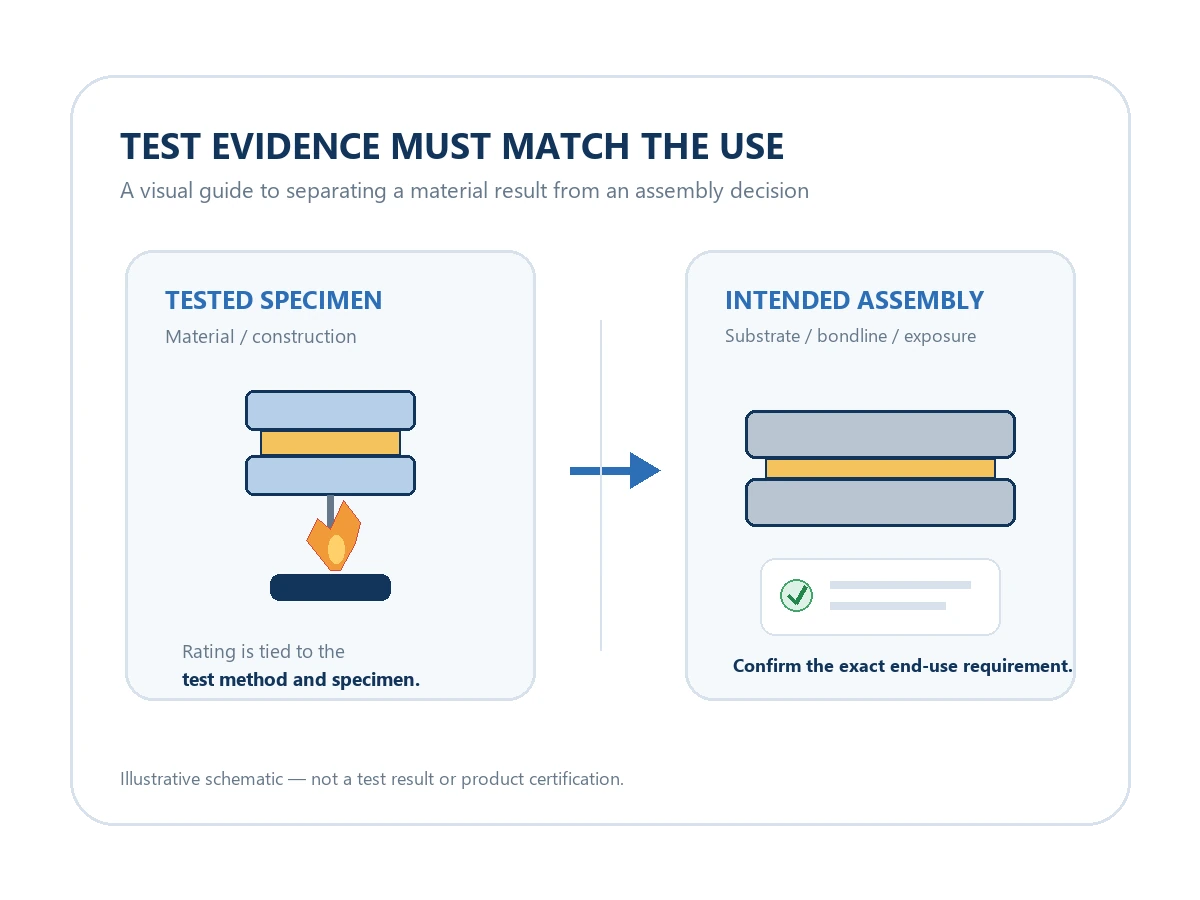
Compare the exact test method and classification, the tested tape construction and thickness, and the OEM acceptance requirement. UL 94 and IEC 60695 specimen results describe the tested method and specimen; they do not, by themselves, prove that a particular battery-pack assembly has passed its customer-specific qualification. In practice, choose a candidate only when its evidence can be traced to the intended tape and requirement. A flame-retardant label is a reason to inspect the file, not a complete qualification record.
Start with the requirement, not the label
Before comparing product names, identify the document that sets the acceptance decision: an OEM drawing note, a material specification, an approved-vendor requirement, or a project validation plan. Record the named standard and edition if one is specified, the requested classification, the component location, and whether the requirement concerns a material coupon, the tape in a bondline, or the assembled component. If the customer has not named a method, mark that as an open requirement. Do not choose a rating on their behalf.
The phrase “flame-retardant tape” alone does not answer which flame exposure, specimen orientation, classification family, or end-use acceptance criterion applies. The exact GSC query “top flame retardant adhesive options for battery pack assembly” appeared four times for Broadya’s product page in the 90-day window, but that is a small site-search signal—not market search volume and not proof of a particular buyer’s specification. The practical response is to turn the requirement into a comparable evidence request before treating products as qualified options.
Read the test family and classification together
UL 94 is not one interchangeable label. UL Solutions describes separate classifications for materials used in enclosures and structural parts, low-density foams, and thin materials. Its guidance explicitly says that VTM-0 cannot be considered equivalent to V-0 because the test methods differ. The same suffix does not make two classifications equivalent. Read the full method and classification printed on the report.
The IEC 60695-11-10 scope describes small-scale laboratory procedures that expose horizontal or vertical test-bar specimens to a nominal 50 W flame source to determine burning rate or self-extinguishing behaviour under the method conditions. The UL Solutions overview separately describes the UL 94 specimen orientations, material groups and classification families. These sources explain what those tests address; they do not identify the requirement for a particular battery-pack project.
A named commercial example shows why the construction matters: tesa identifies its 58375 as a 130 μm double-sided non-woven tape and lists a UL 94 VTM-0 claim for that product. That is a statement about tesa 58375, not a generic result for non-woven tapes and not evidence about Broadya. Use such a page to see how a supplier ties a claim to a named construction; request the underlying evidence needed for your own acceptance decision.
Match the evidence to the tape that will be supplied
A tape construction can include a carrier, adhesive layers, a release liner removed before use, and a converted format. A report that names only a resin, adhesive family, or generic “FR tape” may not make clear what was tested. Ask the supplier to identify the exact product code and construction, nominal thickness and variant, and whether the tested specimen corresponds to the supplied material and the way it will be used. If the product is converted, check whether the report scope still covers the supplied form.
For comparison, capture these fields in one table:
| Evidence field | What to record | Why it changes the decision |
|---|---|---|
| Requirement | Customer clause, standard and edition, requested classification | Establishes the acceptance target instead of guessing it |
| Product identity | Manufacturer, product code, construction, thickness and variant | Connects the result to the candidate actually being purchased |
| Test method | Full standard and method, specimen orientation and preparation | Distinguishes different classification families and test objects |
| Result scope | Classification or measured result, report number, issuer and date | Makes the evidence traceable and reviewable |
| End-use relationship | Whether the customer requires additional bonded-assembly evidence | Separates material screening from project acceptance |
These are comparison and traceability fields, not a claim that every standard requires every field in the same format. The applicable standard, certification scope and customer specification define what is mandatory. Mark absent information “not shown” rather than filling it from a product-family name.
Separate material screening from assembly acceptance
A material classification is useful only within its stated test scope. UL describes UL 94 as small-scale testing of polymeric materials under controlled laboratory conditions. IEC 60695-11-10 likewise defines test-bar procedures. From those scopes, a buyer should not infer that a reported material class alone proves acceptance of a finished battery pack. That is an evidence-boundary conclusion, not a substitute for an OEM or regulatory decision.
The tape may sit between two substrates, near an enclosure edge, or inside a different assembly geometry. The material coupon and the installed bondline are not automatically the same test object. Ask the responsible customer or validation engineer whether the requested evidence must represent the tape alone, the bonded joint, or the relevant part configuration. If an assembly test is required, agree the sample build, substrate, bondline, exposed edges, conditioning and acceptance criteria before comparing suppliers. Do not assume one supplier’s test setup is universally required.
The tesa product page also places responsibility on the user to determine suitability for the application. That is a product-specific disclaimer, but it reinforces a practical sourcing point: a datasheet helps screen candidates; the project owner controls final acceptance. The separate PET tape battery-compartment selection guide discusses a different question—bonding and tape selection for that assembly context—and does not establish flame-retardancy performance.
Use a stoplight decision before sample approval
Keep as a candidate when the report names the exact test family and classification, identifies the product construction and relevant thickness, and can be tied to the customer’s stated requirement. This means the evidence is reviewable; it does not mean the assembly is approved.
Request clarification when a supplier page shows a rating but the report, method edition, tested thickness, variant or certification scope is missing. Ask for the original report or a controlled certification record and have quality compare it against the requirement. A logo or isolated rating in marketing copy is not enough to resolve a mismatch.
Hold the decision when the requested standard is unknown, the evidence refers to a different construction, or the customer requires assembly validation that has not been performed. Do not rank products by V-0 versus VTM-0 without first confirming that both labels answer the same requirement.
This approach avoids two common errors: assuming “flame-retardant” means the same test across suppliers, and assuming a material result automatically qualifies the battery-pack assembly. It lets procurement compare evidence while engineering and quality retain control of the actual acceptance criterion.
What to send with a supplier inquiry
To make an inquiry useful, share the required standard or OEM clause, the tape location in the assembly, the substrate stack, the candidate product code and thickness, and any report already provided. Add the assembly configuration and the customer’s acceptance criteria if bonded-part testing is required. Do not send confidential drawings unless your process permits it; a redacted sketch or controlled reference may be enough for an initial discussion.
For reference, see the Broadya flame-retardant tape product page. The page is a product-category entry point; this guide does not assert a Broadya rating, certification, or battery-pack approval. Product matching, evidence availability and supply capability must be confirmed separately against the project requirement.
Discuss the evidence for your application
Share the required test clause, tape construction, substrate stack and assembly context. This is an evidence review request, not a product qualification promise.