
BUYER'S GUIDE · PET DOUBLE-SIDED TAPE
How do you select PET double-sided tape thickness for a bond line?
PET double-sided tape thickness should be selected from the joint geometry, part tolerances, surface condition, and assembly process—not from a simple rule that thicker tape is always stronger. The supplied catalogue lists PET tape models from 30 to 205 microns.
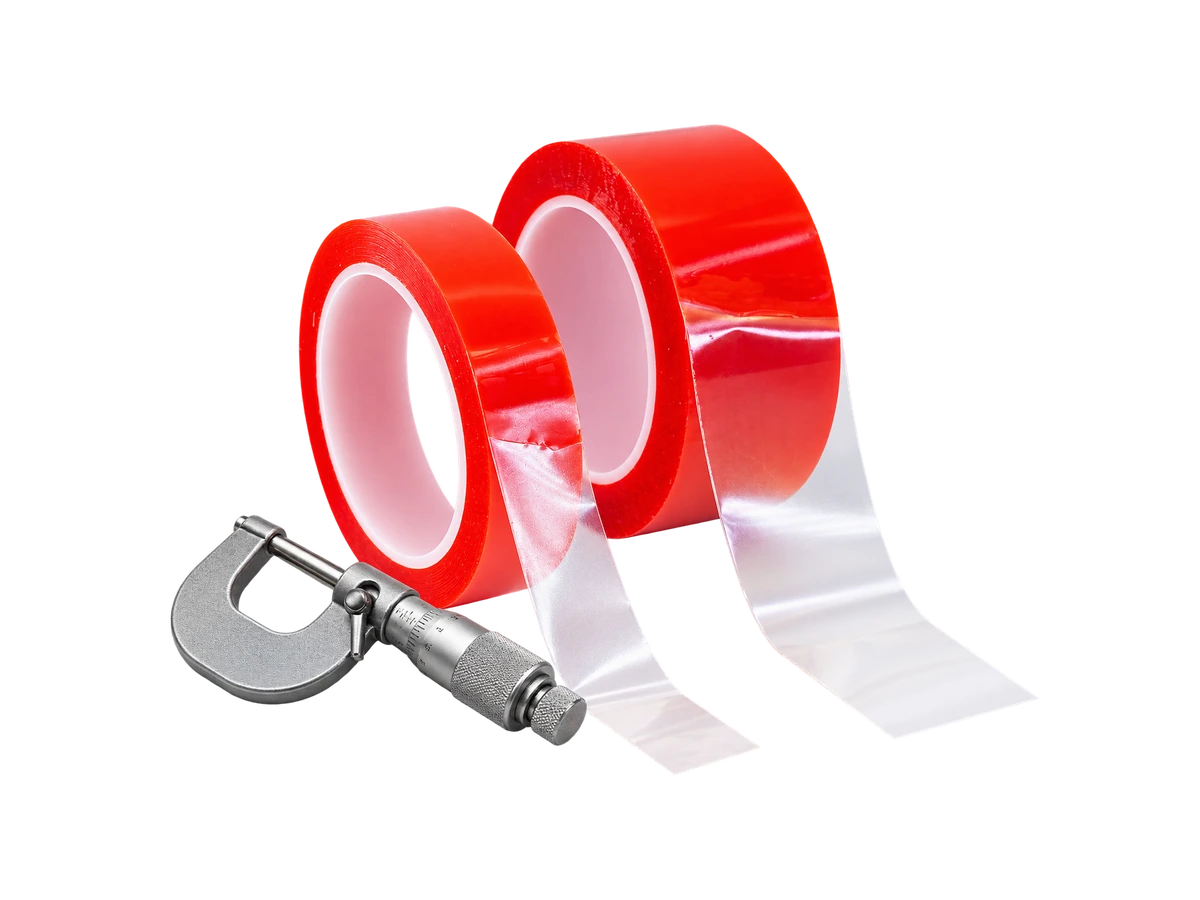
PET double-sided tape thickness should be selected from the joint geometry, part tolerances, surface condition, and assembly process—not from a simple rule that thicker tape is always stronger. The supplied catalogue lists PET tape models from 30 to 205 microns. That range can help buyers define candidates, but the right construction depends on how the actual parts meet and how the assembly will be qualified.
Start with the joint drawing
Show the two materials being joined, the effective bond width, overlap, edge shape, curvature, and any area where adhesive must not appear. A drawing helps distinguish a flat, controlled interface from a joint with molded texture or local variation. Record the nominal gap and the tolerance range rather than relying only on a single measurement.
Also note the condition of each surface. Paint, coatings, mold texture, contamination, protective films, and surface treatments can change contact. These factors may matter more than a small change in nominal tape thickness, so include them in the sample plan.
For current PET constructions and listed application context, review the double-sided PET tape product page and the PET tape specifications and selection guide before fixing a candidate for the joint.
Use the catalogue range to frame candidates
The PET catalogue lists these models and thicknesses: BY6983G at 30 μm, BY6972G at 50 μm, BY6980G at 80 μm, BY6982G at 100 μm, BY6928G at 125 μm, BY6967G at 160 μm, and BY6965G at 205 μm. Treat these as catalogue-listed options, not a universal ranking. Ask which exact model and construction are being proposed for your joint. For current constructions and listed applications, see the Double Sided PET Tape product page.
A thinner construction may be worth evaluating where the stack-up is tightly controlled and the bond line is flat. A thicker construction may be considered when the joint geometry has more variation, but it should not be used to mask an unresolved tolerance problem. If the gap changes widely across the part, first determine whether the design or assembly process needs correction.
Separate thickness from performance
Thickness alone does not establish peel strength, shear resistance, impact performance, environmental durability, or suitability for a specific substrate. Those outcomes depend on more than the nominal thickness, including adhesive chemistry, surface condition, bond area, pressure, dwell, and loading direction. Do not infer that a thicker tape will meet a load target unless the relevant construction has been tested under representative conditions. For broader model and specification context, read the PET Tape: Specs, Uses & Selection.
When comparing samples, keep the other variables as consistent as possible. Use the same substrates, cleaning process, bond width, application pressure, and conditioning. If several properties change at once, it becomes difficult to understand why one sample performed differently.
Check fit and conversion details
The tape’s finished width should match the usable contact band and placement tolerance. If the design requires a narrow strip, die-cut shape, or liner tab, include a drawing and specify the allowed dimensional variation. The catalogue lists master widths of 1040 mm and 1240 mm; these do not by themselves establish a specific slit width, roll length, or converted part availability.
Ask about the liner as part of the thickness discussion. White paper, MOPP red film, and yellow grid paper are listed options. The production line may need a liner that supports clean registration, manual handling, or automated dispensing. A candidate that fits the thickness target but cannot be handled reliably may not be suitable for the process.
Build a simple comparison matrix
For each candidate, record model, nominal thickness, liner, finished width, substrate pair, surface finish, application method, pressure, dwell, and conditioning. Inspect the part immediately after application and again after the planned qualification interval. Record edge lift, displacement, bubbles, wrinkles, adhesive transfer, cosmetic effect, and failure mode.
Define acceptance criteria before testing. For example, state the allowable placement offset, whether any edge lift is acceptable, and how the part will be inspected. Use the organization’s actual design and quality requirements; do not borrow generic values from another application.
Questions to ask a supplier
Ask the supplier to confirm the exact catalogue model, available construction, liner, and whether the requested finished width is feasible. Ask what product documents apply to the sample and what properties still require customer-side validation. If temperature, compliance, or service-life requirements are part of the application, request the corresponding scoped documentation rather than relying on a broad product description.
Selecting thickness is a controlled engineering decision. The catalogue range gives buyers a useful shortlist, while the drawing, process details, and representative test determine whether any candidate fits the real bond line. With those details ready, Request a PET tape quote or sample.
How to compare two thickness candidates
If the design team has not selected a thickness, create a small candidate table rather than asking for an undefined “best tape.” List the product model, nominal thickness, liner, converted width, and the reason for including the candidate. Keep the substrate pair and application procedure constant across the comparison. This makes the result useful even if neither option passes: the record can show whether the issue appears tied to stack height, handling, surface contact, or another factor.
Do not accept a thickness recommendation without recording its basis. A supplier may be offering an initial sample based on the drawing, a catalogue match, or a prior application example. Those are different levels of confidence. Ask what assumption led to the recommendation and what test would confirm or reject it for this bond line.
When the geometry changes, revisit the result. A new gap, part tolerance, coating, or bond width can make the previous thickness decision no longer representative.
Discuss your PET tape application
Share the substrate pair, bond-line dimensions, assembly conditions and target volume so our team can review a suitable PET tape construction and sample format.