
BUYER'S GUIDE · PET DOUBLE-SIDED TAPE
What should you verify before using PET double-sided tape on PP or PE surfaces?
The supplied PET product catalogue lists PP and PE among the application surfaces for PET double-sided tape. That listing makes the materials relevant to a sourcing discussion, but it does not prove that every grade, finish, additive package, or molded part will bond successfully.
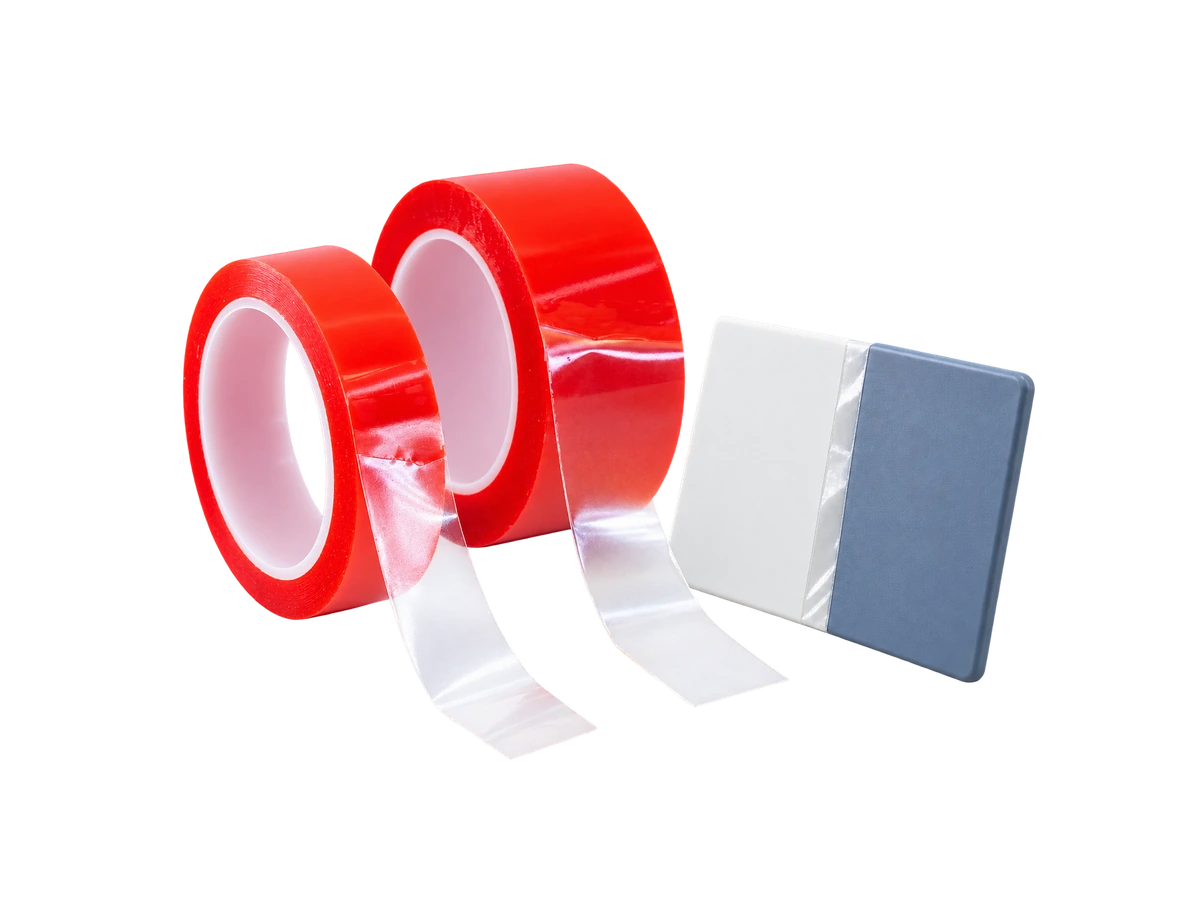
The supplied PET product catalogue lists PP and PE among the application surfaces for PET double-sided tape. That listing makes the materials relevant to a sourcing discussion, but it does not prove that every grade, finish, additive package, or molded part will bond successfully. Buyers should identify the exact surface and validate the proposed construction on representative parts before approving a production use.
Confirm the substrate identity
“PP” and “PE” cover many grades and part conditions. Provide the resin grade if available, molded or extruded process, color, texture, coating, and any surface treatment. Identify whether the part has a release agent, lubricant, protective film, or other residue. If the material supplier or formulation may change, record that as a change-control item. For current constructions and listed applications, see the Double Sided PET Tape product page.
Include the second adherend as well. A joint between PP and painted metal is different from one between two polymer parts. Show the bond width, edge exposure, curvature, and required placement tolerance on a drawing. Photographs can clarify texture or geometry that a short text description misses.
Treat catalogue application as a candidate signal
The PET catalogue describes a PET film carrier, oil-based adhesive, and a 30–205 micron range. It lists models at 30, 50, 80, 100, 125, 160, and 205 microns, with white paper, MOPP red film, and yellow grid paper liner options. These facts help define a sample request. They do not rank the options for a particular low-energy surface. For broader model and specification context, read the PET Tape: Specs, Uses & Selection.
Ask the supplier to identify the exact proposed model and the evidence available for that surface. If the recommendation is based on general experience rather than a scoped test, keep that distinction visible in the technical review. Do not present a product-family application note as proof for a particular resin grade.
Control surface preparation and application
Document the cleaning agent, wipe method, drying time, application pressure, tool or roller, dwell before handling, and storage condition. Use the same steps in sample testing that the production team intends to use. If a surface treatment is required, specify who applies it and how the treatment level is verified.
Avoid changing several process variables between samples. If a candidate does not meet the agreed criterion, test a controlled adjustment such as surface preparation, bond width, tape model, or dwell. Record the reason for each iteration so the result can be reproduced.
Test the finished joint under actual loading
Prepare assemblies from production-representative parts and apply the tape using the planned process. Inspect placement, edge contact, wrinkles, exposed adhesive, and any initial movement. Then use the buyer’s qualification protocol to assess the loads and environments relevant to the application.
Record where failure occurs: at the tape-to-PP/PE interface, at the opposite interface, within a component, or because of part deformation. This failure location helps determine whether the next step should be a different tape construction, process change, design revision, or further investigation. Do not substitute a generic peel test for a service-representative evaluation if the joint experiences a different loading mode.
Use the listed substrate information on the PET tape product page as a candidate signal, then validate the exact PP or PE surface and process against the guidance in the PET tape selection article.
Be careful with environmental and compliance claims
If the application involves heat, humidity, chemicals, UV exposure, or outdoor use, state the actual conditions and duration required by the project. Ask for evidence that matches the exact product and test scope. A general catalogue application statement does not establish long-term durability under those conditions.
The PET catalogue includes a RoHS statement. Request the actual report or declaration as needed and verify product identity, revision, and scope. Compliance documentation and substrate qualification answer different questions and should be reviewed separately.
Supplier request checklist
Send resin grade, part drawing, surface finish, surface-treatment details, mating material, bond area, loading direction, expected environment, application process, target thickness, liner preference, sample quantity, and acceptance criteria. Ask the supplier to mark the product facts, engineering recommendations, and unresolved validation items separately.
PP and PE can be included in a PET tape evaluation because they appear in the supplied application list. A production decision still depends on testing the actual materials, surfaces, and process—not just the polymer abbreviation. With those details ready, Request a PET tape quote or sample.
Change control after qualification
A successful trial applies to the materials and process actually tested. Define which changes trigger review: resin grade, mold release practice, surface coating, colorant package, cleaning agent, tape model, liner, bond width, or assembly pressure. The quality team can decide which changes require a complete retest and which need a focused confirmation, but the decision should be documented before production lots change.
Keep a retained sample and link the approval to the drawing revision and product identification. If field or production feedback later reports edge lift or movement, compare the failed parts with the qualified process record before making a broad claim about the tape family. The failure may relate to a changed substrate, contamination, storage, geometry, or another condition outside the original trial.
This discipline is especially useful when the same polymer label covers parts from multiple suppliers. “PP” or “PE” is not a complete surface specification.
Discuss your PET tape application
Share the substrate pair, bond-line dimensions, assembly conditions and target volume so our team can review a suitable PET tape construction and sample format.