
MATERIALS & TECHNOLOGY · CARRIER SELECTION
Double sided tissue tape uses: where a tissue carrier works, and where it fails
A tissue carrier bonds well and carries nothing. Load path, surface flatness and dwell time decide whether it is admissible — before any grade or price comparison.
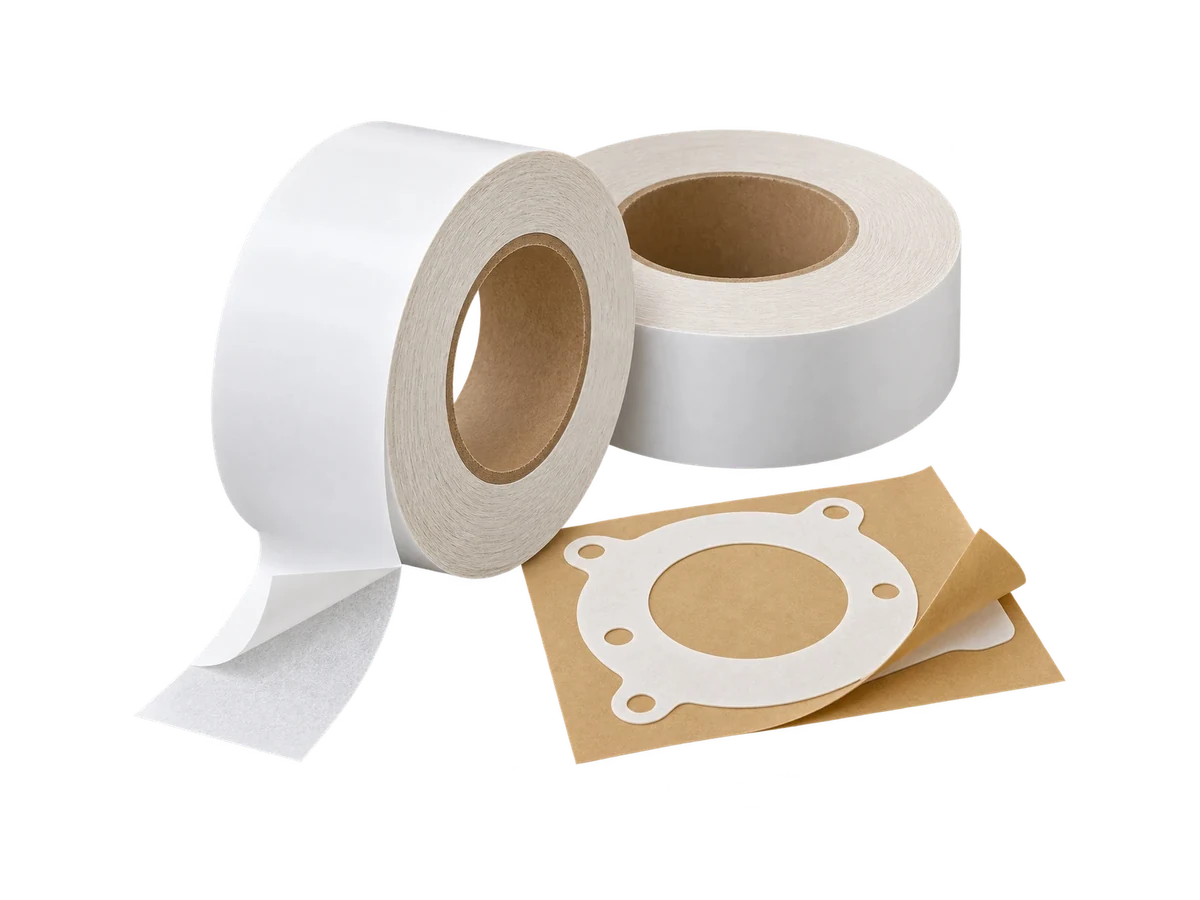
Double sided tissue tape is usually chosen because it is thin, cheap and easy to die-cut. Those are real advantages, and they are also why it gets used in places it cannot survive. The carrier decides the outcome, not the adhesive: a tissue carrier is a short-fibre paper web with no reinforcing element, so it bonds well and carries nothing.
That single fact sorts most applications before any sample is ordered. If the joint has to hold load through the tape itself, tissue is the wrong carrier. If the surface is flat and the load arrives after the adhesive has wetted out, tissue is often the most economical correct answer. The four sections below turn that into a decision you can make in a meeting.
What a tissue carrier is, and what it is not
A double sided tissue tape is a five-layer stack: release liner, adhesive, tissue paper carrier, adhesive, release liner. Broadya documents the tissue range at 80 to 180 µm with acrylic or modified acrylic adhesive, translucent, rated to 100 °C, with the standard family stocked at 80 to 120 µm.
The carrier is the middle layer, and its job is to give the adhesive two faces to sit on plus a controlled thickness. It is not a structural member. Paper fibres are short and unbonded; there is no woven grid, no continuous film, no filament. Compare that with the alternatives a converter normally has on the desk:
| Carrier | What it contributes | Where it stops |
|---|---|---|
| Tissue paper | Thin, conformable, cheap, clean die-cutting | Carries no tensile or shear load |
| Non-woven fabric | Bonded fibre web with real tensile and tear strength | Thicker, stiffer, higher cost |
| PET film | Dimensional stability and high tensile strength | Low conformability, needs a flat surface |
| Foam (PE/EVA) | Gap filling, stress distribution | Bulk, not a thin bond line |
The practical reading: tissue and non-woven are not grades of the same thing. One is a coating substrate, the other is a reinforcement. Suppliers who use “tissue tape” as a blanket term for both are the reason buyers end up with the wrong one.
If the carrier question is still open across all four families, the double sided tape selection guide runs the same order — substrate, gap, load, service condition — before any grade is compared.
The first dividing line: does the tape carry the load?
Ask one question before thickness, before adhesive, before price: when this joint is under load, does the load pass through the tape?
If yes, tissue is out. This is not a matter of picking a better tissue grade — there is no grade in the family with a load path. Pioneer Tapes makes the distinction explicitly when describing its non-woven range: standard tissue is right for nameplate mounting and film splicing, but where the tape itself carries mechanical stress — reinforcing a sewn seam, holding a paper web during manual splicing, forming a core-starting tab — a non-woven carrier provides tensile strength that a plain tissue carrier cannot. The same source notes that a tissue construction is the wrong pick precisely where the bond line is expected to absorb tension.
The load case shows up in three common shapes:
- Tension along the bond line — a web tail, a core-start tab, a seam that gets pulled during handling.
- Shear under sustained dead load — a panel hanging on a vertical face for months.
- Peel concentrated at a narrow edge — a thin strip holding a part that wants to lever away.
None of these are adhesive problems. A tissue tape can show a respectable peel number on a lab plate and still creep or split at the carrier in service, because the number measured the adhesive and the failure happened in the paper.
Where load is low and carried by the substrates — a nameplate sitting flat on a painted panel, a foam pad inside an enclosure — the carrier never sees the load and tissue is fine.
When the surface is not flat
Tissue conforms to mild irregularity and nothing more. At 80 to 180 µm the tape is thin enough that a gap, a weld seam, a texture or a curve is transmitted straight through it, and the adhesive only contacts the high points.
Two consequences follow:
- Do not use tissue to fill a gap. Gap filling is a PE foam carrier job: the foam deforms and keeps contact across an uneven interface, while a tissue carrier just bridges and leaves voids.
- Do not use tissue on a curved or flexible joint that will move. The paper carrier has no elongation to give. Where a part must follow a curve under load, a non-woven carrier keeps conformability while adding strength — that is the case it was designed for.
The check is mechanical, not visual. Put the tape on the actual part, apply the real pressure for the real dwell, peel it back and look at the contact pattern. If you see a patchy imprint rather than a full transfer, the surface is not flat enough for a tissue construction regardless of how the sample felt.
Dwell time: the failure that looks like a bad batch
Most “the tissue tape failed” reports are not carrier failures at all. They are load applied before the adhesive finished wetting out.
Acrylic pressure-sensitive adhesive develops strength on a curve, not at contact: roughly 50% immediately, about 75% at one hour, around 90% at 24 hours and full strength at 72 hours. The figures are industry-typical values, not a Broadya datasheet, but the shape of the curve is what matters. If a part is bonded and immediately loaded — hung, stacked, packed, shipped — it is working at about half its rated strength.
Tissue is more exposed to this than a foam or thick film construction, for a simple reason: the bond line is thin, so there is very little adhesive mass to accommodate early movement. A thin bond line that is loaded too soon shows edge lift or a creeping part, which reads as a weak tape when it is an unfinished cure.
The fix is scheduling, not product: fixture or stage the assembly so the joint is not loaded for the first shift, and specify 72 hours where the joint is critical. In cool conditions below about 15 °C, allow roughly double.
Temperature and the 100 °C ceiling
Broadya lists the tissue range to 100 °C. That is a ceiling for the construction, not a licence to run at it continuously, and it is well below what a PET or polyimide carrier will take.
Two distinctions keep the number honest:
- Peak versus continuous. A short excursion through a dryer or a lamination nip is not the same as a sustained service temperature. Ask what the joint actually sees for how long, and compare like with like.
- Carrier versus adhesive. Above the carrier’s comfortable range the paper can embrittle or the adhesive can soften, and the two fail differently. The visible result — edge lift versus a clean split — tells you which one moved.
If the service temperature is above 100 °C, this is not a tissue conversation any more. Move to a film carrier and re-run the load question, because a high-temperature film will also change the conformability answer.
Where tissue tape is the right answer
What double sided tissue tape is used for narrows to four families, and each one holds only while its condition holds — there is no fifth family where tissue does something a reinforced carrier does better:
| Use | Why tissue fits | Condition that must hold |
|---|---|---|
| Carton closing and print finishing | Instant grab on paper and board, clean finish, low cost per metre | Smooth paper surface, low load, short service life |
| Nameplate and badge mounting | Thin, discreet bond line on a flat rigid face | Substrate flat, load carried by the panel, no sustained peel |
| Light internal electronics assembly | Thin, clean, die-cuts to small shapes, no bulk inside an enclosure | Low-stress parts, no heat above the rating, no load through the tape |
| Furniture veneer and backing board | Fast grab, forgiving on paper-like surfaces, easy to handle | Flat panel, load carried by the panel and the press cycle |
The pattern across all four is the same: flat surface, low load, short or unloaded service. That is a large part of the converting and assembly market, which is why tissue is the volume product — and why it gets over-applied.
What tissue tape cannot do
State the limits plainly, because they decide more projects than the advantages do:
- It cannot carry tension. For a web tail, a core start or a seam under pull, use a non-woven or a mesh carrier. The mesh construction exists for exactly this: a fibreglass grid in a 100 to 200 µm build holds a seam that a paper carrier would stretch.
- It cannot fill a gap. Use foam.
- It cannot survive sustained temperatures above its rating. Use PET or polyimide film.
- It cannot be assumed repulpable. A tissue face says nothing about whether the adhesive and liner disperse. If the trimmed web goes back into a pulper, the construction has to be qualified as a whole, not by the word on the box.
How to test the carrier decision in one shift
The carrier question is settled by failure mode, not by initial tack. Run three checks on the real joint, same width, same liner, same substrate:
1. Peel in the direction the joint will actually be loaded. Record the number and where it separated — adhesive or carrier.
2. Elongation under load. Hang a known mass and measure movement over an hour. A tissue construction will creep where a non-woven or mesh holds.
3. Edge notch tear. Nick the edge and pull. If it propagates through the carrier, that carrier has no tear resistance to offer.
Whichever check first reproduces the failure you are trying to prevent names the carrier you need. If none of them fails, tissue is the cheaper correct answer and you should stop looking.
Frequently asked questions
Is tissue tape the same as non-woven tape?
No, and the difference is structural. Tissue is a short-fibre paper carrier with no reinforcement; non-woven is a bonded fibre web with real tensile and tear strength. Many suppliers use “tissue tape” loosely for both, so confirm the carrier before comparing prices.
Can tissue tape be used for splicing?
It can, for light manual splicing where the tape does not carry web tension. Where the splice must hold tension — a flying splice, a core start, a machine-direction joint — the carrier has to take load, which means non-woven, mesh or a film-backed construction instead.
Which thickness of tissue tape should I choose?
Broadya lists 80 to 180 µm with the standard family at 80 to 120 µm. Choose against the measured gap and the flatness of the interface, not against the thickest option: a thicker tissue does not add load capacity, it only adds bond-line thickness.
Why does tissue tape fail after a few days when it held at first?
Usually dwell, not the tape. Acrylic adhesive reaches roughly 50% strength at contact and full strength only around 72 hours; a joint loaded on the first shift is working at half its rating. Check the loading timeline before changing suppliers.
Next step
Send the substrate pair, a photo of the joint, the load direction and magnitude, the service temperature, and whether the trimmed part goes back into a pulp or recycle stream. We will tell you whether a tissue construction holds — and if it does not, which carrier to evaluate instead.
- Substrate pair and a photo of the joint
- Load direction and magnitude
- Service temperature and dwell
- Whether the trimmed part returns to a pulp or recycle stream
Discuss your application
Tell us the substrate, the joint and the service conditions. We reply with what fits and what does not.