
SELECTION GUIDE · MESH TAPE
How to Evaluate Double-Sided Mesh Tape for Flexible Substrates
Screen both bond faces, the mesh carrier and the real joint before specifying tape for flexible materials.
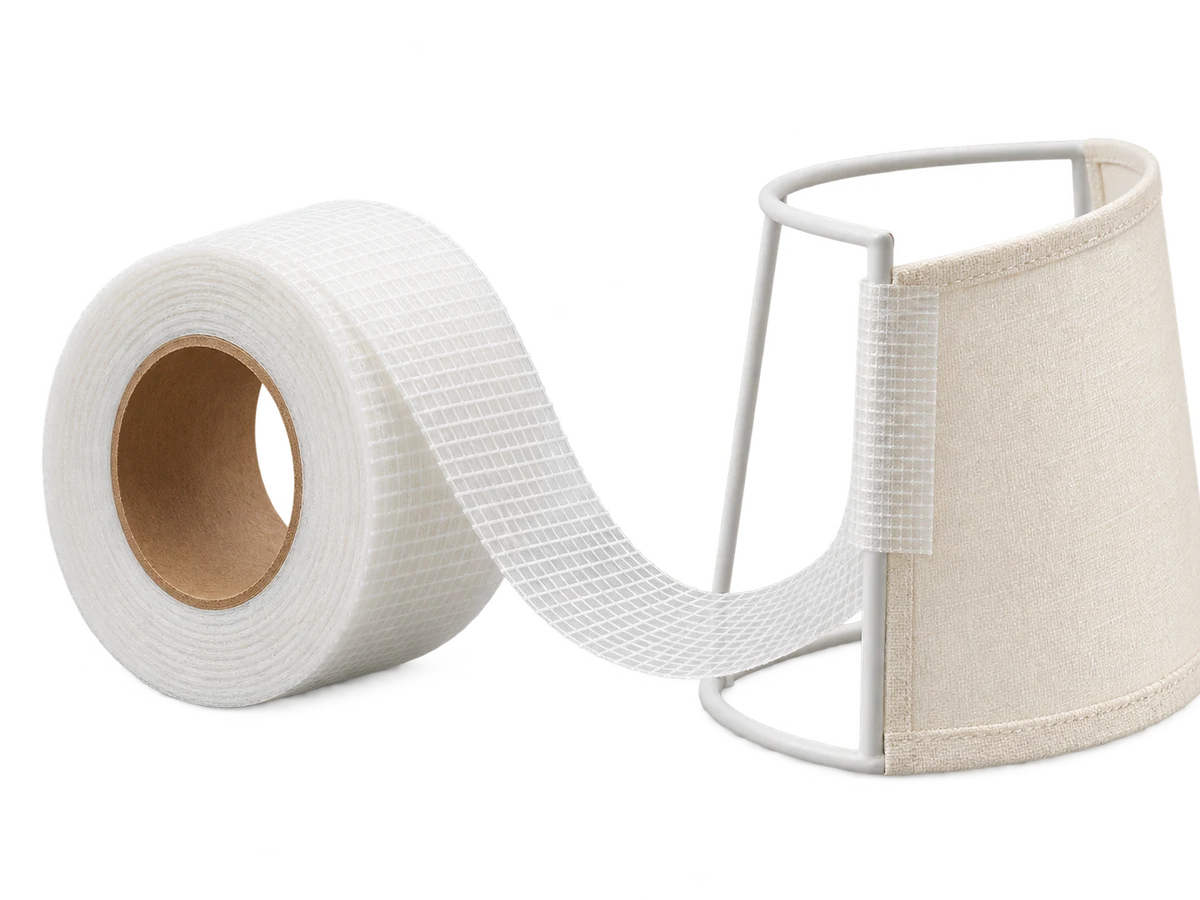
Double-sided mesh tape for flexible substrates should be screened as a joint, not by tape thickness or a steel-peel number alone. First identify the two actual bonding faces and whether the adhesive can make useful contact with each. Then test the reinforced carrier against the joint’s real peel, folding and handling directions. A tape that stays dimensionally stable during application can still release from a porous fabric, finished leather or soft foam. Neither a supplier’s general application list nor a nominal 100 µm option establishes performance in a particular assembly.
Start with the two interfaces and the load path
A double-sided tape makes two separate adhesive interfaces. In a fabric-to-frame joint, one face meets the fabric and the other meets the frame coating or metal; in a fabric seam, both faces may meet textile, but their finishes and orientations may differ. Record the exact material grade, finish and coating on each side. A fabric’s loose fibers, a foam’s weak cell surface or a leather finish can become the failure plane even when the adhesive itself remains intact.
The mesh or scrim is a reinforcement within the construction. It can improve handling and resist unwanted extension of a long tape run, but it cannot compensate for poor adhesive contact at either surface. 3M’s adhesion guidance explains why firm application pressure and sufficient contact time matter to pressure-sensitive adhesive wet-out. A mesh-tape supplier’s guidance distinguishes porous from nonporous bonding surfaces and describes the scrim’s dimensional role. Those are industry mechanisms, not measured results for a Broadya construction.
A mesh carrier is useful only when its dimensional restraint solves the actual problem. If a soft foam surface or deep texture prevents enough adhesive contact, reinforcement alone is the wrong fix. ADDEV Parafix’s foam-bonding guidance distinguishes a conformable transfer construction for uneven foam from a film-backed construction used when added stability is needed. Those examples describe other products, not Broadya mesh performance. For a sample shortlist, compare contact on the real surface and carrier movement during handling; if contact fails while the carrier remains stable, change the adhesive or construction rather than increasing mesh strength.
For screening, draw the intended force direction on the joint. Peel at an exposed edge is a different demand from in-plane holding, and repeated folding can move the highest stress to a different location. If the assembly has a narrow seam or free edge, test that geometry rather than relying only on a flat coupon. Compare failure modes: clean release at one interface points to an adhesion or surface problem; substrate tear points to the material’s own limit; deformation or splitting within the tape points to the construction. Record the time and temperature at which each observation occurs.
Decide what the 100 µm requirement actually measures
The number must be attached to a construction definition. Is 100 µm the fiberglass carrier, the finished adhesive-and-carrier tape without liner, or the supplied stack including release liner? These are not interchangeable specifications. For example, Nitto’s D5052 product data explicitly defines its reported 0.140 mm tape thickness as total thickness without liner; that figure belongs to Nitto’s nonwoven construction and is not a Broadya mesh-tape result.
The current Broadya mesh tape product page lists 100, 150 and 200 µm reference options and a glass-fiber carrier, while directing selection to the applicable model and sample. The page does not establish that a 100 µm option is qualified for a fabric seam or lampshade frame. Ask for a model-specific cross-section and thickness definition, then set an assembled bond-line tolerance that the parts can accept. Where an apparent 100 µm target comes from a buyer request, treat it as a target specification until that construction and tolerance are confirmed.
Use the lampshade case to bound the evaluation
For a lampshade, separate fabric-to-frame attachment from fabric seam closure. The first may pair porous or coated textile with painted metal or another frame surface; the second may involve two textile finishes and a visible edge. The geometry changes the dominant peel direction, appearance requirement and feasible tape width. A visible grid imprint, adhesive bleed-through or edge lift could reject a candidate even if initial tack feels strong.
Measure the temperature at the bond line during normal operation and the time spent there; do not substitute the lamp rating or a generic tape temperature claim. IEC 60598-1:2024 sets general safety requirements and tests for luminaires. Its existence does not certify any adhesive or this lampshade assembly. Any applicable luminaire safety assessment and any joint durability claim require the actual design and test scope. Heat exposure, lighting configuration and required life remain unknown for this buyer request.
Build a sample test that can change the decision
Prepare matched samples on the production fabric, foam or nonwoven and the opposing surface. Apply them using the intended pressure, dwell, liner removal and handling sequence. Test an edge peel in the direction most likely during assembly and use; inspect at initial handling and after a representative dwell. Repeat after the assembly’s measured temperature exposure if heat is relevant. Include the real seam width, fold radius and edge position. Record the failure plane and any visible damage, bleed-through or grid telegraphing.
Advance a construction only when both interfaces and the carrier remain acceptable in the actual joint. If the tape releases cleanly from a fabric finish, changing nominal thickness alone is unlikely to solve that interface; investigate adhesive compatibility or the surface specification. If the carrier distorts while the adhesive remains attached, investigate reinforcement and process tension. If the substrate tears, the acceptance criterion must account for the substrate limit. These are diagnostic interpretations of observed failure modes, not a promise that a particular Broadya product will pass.
Next step
To assess a candidate, send the two named substrates and finishes, a sketch of the joint, whether it is a frame attachment or seam, the intended 100 µm thickness basis and tolerance, tape width, application pressure and dwell, expected peel/fold direction, and measured operating temperature at the bond line. The result should be a model-specific sample and test plan before a production specification is released.
Discuss your application
Share both substrate finishes, joint geometry, thickness basis and bond-line temperature so a model-specific sample test can be scoped.