
CONVERTING & OEM · FOAM GASKET SELECTION
Adhesive-Backed Foam Gaskets: Select the Part Around the Seal
Assess whether the joint, material and evidence support an adhesive-backed foam gasket.
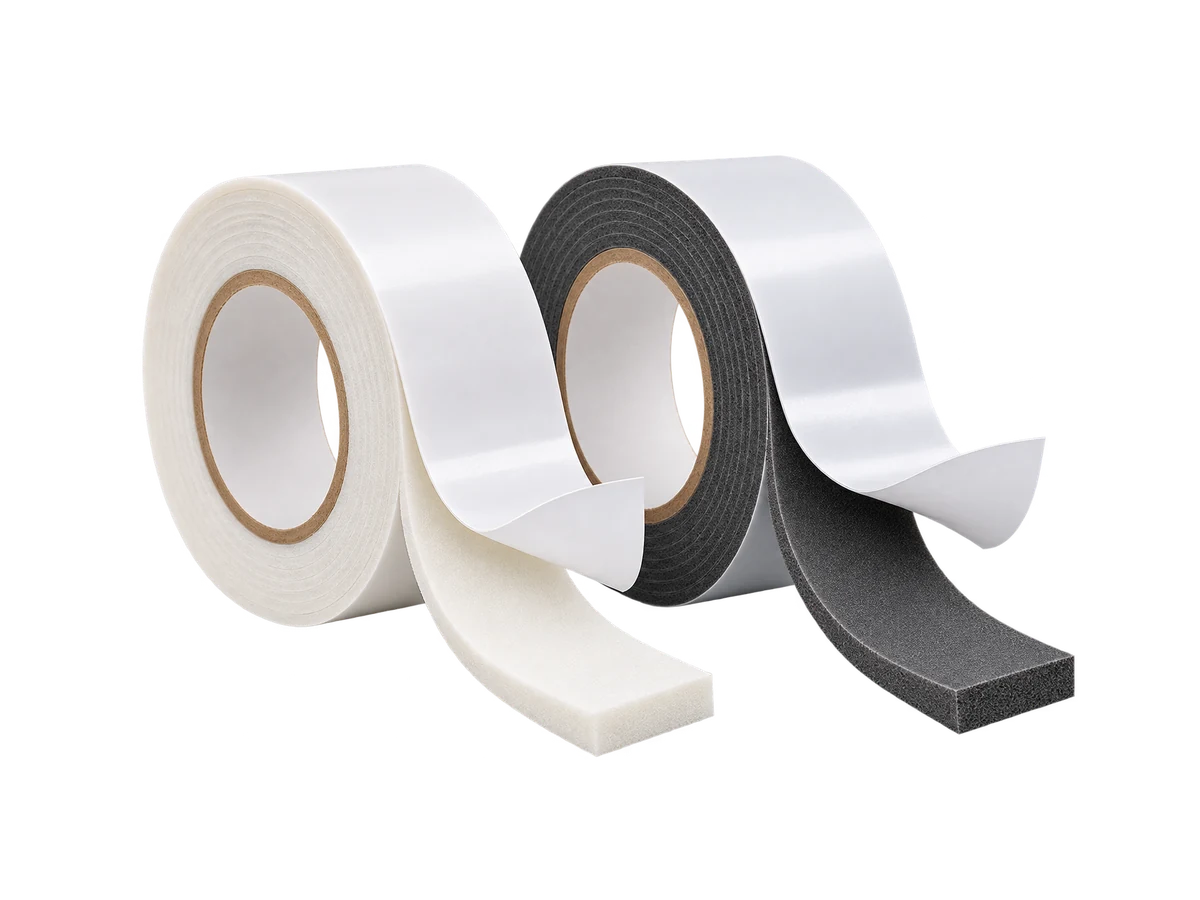
An adhesive-backed foam gasket is a plausible candidate when a static joint needs a shaped, compressible interface and the adhesive mainly locates or retains the gasket during assembly. Start with the sealing path, the joint gap, the mating surfaces, and the exposure the assembly must withstand. A foam outline and pressure-sensitive adhesive do not by themselves prove a fluid, air, dust, or moisture seal. The specific construction and closure condition must be assessed against the intended function. In a custom die cut gaskets sourcing brief, define the joint and proof required before treating the shape as a qualified seal.
Define the sealing path
First name the outcome that “seal” means for this assembly: block dust, limit moisture ingress, contain air, prevent a liquid leak, or close a visible gap. State the medium, pressure or exposure condition, duration, and what result counts as acceptable. A dynamic or pressure-loaded joint needs a more specific design basis than a simple static cover; a generic foam tape description cannot qualify it.
Draw the assembled joint, not only the gasket profile. Mark the full sealing path, interruptions, fasteners, holes, corners, cable entries and any feature that could form a leak route. Identify the two surfaces the gasket contacts and where the adhesive-backed face holds the part during assembly. Tie each critical edge and opening to a drawing datum and an acceptance check. A correct outline can still miss the functional path if a corner, splice, or opening leaves an uncovered route.
The Broadya PE foam tape page lists sealing and gasketing among PE foam tape application directions and shows die-cut gasket formats. This makes PE foam a product-family candidate to assess, not a model-specific seal rating. The page directs buyers to provide substrate, gap, service conditions and application information for sample validation. Keep that difference explicit: a listed use starts a project review; it does not prove that a particular construction meets an ingress or leakage requirement.
JBC’s gasketing and sealing overview describes use cases from dust and moisture protection to gap filling, across materials including open- and closed-cell foams, rubber, cork, aramid fiber and graphite. This range shows that “gasket” names a part role, not one universal material class. Those third-party material examples do not imply that every listed material is offered by Broadya.
| Joint variable | What to define | Why it changes the decision |
|---|---|---|
| Seal duty and medium | Dust, moisture, air, liquid, pressure, exposure time and pass/fail result | A visible gap fill and a tested leak barrier are different acceptance tasks |
| Motion | Static closure, repeated opening, vibration or relative movement | Movement can add peel or cyclic loading at the attachment and seal path |
| Mating surfaces | Material, coating, finish and preparation on both sides | Adhesion and contact depend on the actual surfaces, not just substrate names |
| Path geometry | Corners, fasteners, holes, splice points and interruptions | A local gap can break an otherwise continuous outline |
Check gap and compression space
Record the minimum and maximum assembled gap across the drawing tolerance stack. Include flatness, surface texture, fastener spacing and local steps that change closure. The gasket must contact both sides around the intended path under the worst-case assembly condition. Selecting from nominal dimensions alone can hide an open route at the largest gap or excessive squeeze at the smallest one.
Do not choose foam thickness by appearance or a generic compression percentage. The usable range depends on the selected foam construction and joint design. Obtain the applicable model-level data, compare it with the closure range, and evaluate the actual construction at the relevant gap extremes. If the joint relies on a hand-set position or has no controlled closing force, reproduce that assembly condition in the sample test.
Also list what reaches the joint: water, oil, cleaning agents, outdoor exposure, heat, humidity or pressure cycling. Record both substrate materials and surface finishes. Adhesion to a coating can differ from adhesion to its underlying metal or plastic, and a bond that remains attached under one condition may not preserve the seal under another. If the requirement depends on an unverified ingress rating, chemical compatibility, temperature range, compression recovery or regulatory status, record it as an evidence gap instead of inferring it from “PE foam.”
Broadya’s public page lists reference PE foam thickness options and says to confirm the applicable model specification. It does not publish one compression curve for every construction or every gasket geometry. For a narrow gap window, repeated disassembly, long-term compression recovery or a high closing force, the selected material’s evidence and a representative sample become decision inputs—not optional finishing checks.
Treat adhesive as a mounting interface
Separate the gasket body from the adhesive interface because they solve related but different problems. The foam body must maintain the required contact around the joint. The adhesive-backed face normally helps position or retain the part on one component before closure. A strong attachment to one surface does not establish that the perimeter blocks the required medium after the joint is assembled.
Describe these functions separately in the part brief:
- Seal contact: which faces touch the mating parts and what continuous path must stay closed.
- Attachment contact: which face carries adhesive, what surface it bonds to, and whether it only locates the gasket or also carries a defined load.
- Closure: how the parts are assembled and whether compression is even around the path.
- Exposure: the medium and conditions the joint must withstand.
Add a cross-section to the drawing or sample brief: identify the foam body, which face carries pressure-sensitive adhesive, the release liner or liners, and the assembled compression space. Mark the face that attaches to the first component and the face that contacts the second. The liner is a handling layer; it does not establish sealing performance after assembly.
If the attachment itself must resist peel, movement, repeated opening, or a difficult-to-bond finish, specify that as its own requirement and test the actual surface pair. Do not use the adhesive’s presence as a shortcut for the seal design. The gasket profile, foam response, joint closure and attachment each need evidence appropriate to their role.
Know when a foam tape gasket is outside the evidence boundary
Pause a final material decision when the requirement depends on an unverified pressure limit, fluid compatibility, ingress rating, compression recovery, temperature range, or regulatory approval. Also pause when the seal path includes a splice, sharp turn, moving surface or gap variation that has not appeared in the test sample. These conditions do not automatically rule out PE foam; they mean the available product-family description does not answer the specific engineering question.
| Requirement | Why the public PE foam family page is not enough | Evidence to close the gap |
|---|---|---|
| Defined water or dust ingress target | “Sealing” application wording is not a stated ingress result | Test the complete assembly to the buyer’s chosen method and acceptance limit |
| Fluid, cleaner or chemical exposure | Compatibility can depend on the exact foam and adhesive construction | Model-specific compatibility evidence or a conditioned sample test |
| Pressure or leakage limit | A die-cut gasket shape does not state a pressure rating | Pressure and leak test on the actual joint design |
| Compression recovery over time | Family-level thickness options do not provide every model’s compression behavior | Model-specific data plus a representative closure and aging test |
| Repeated opening or moving joint | Repeated motion changes both seal contact and adhesive stress | Cycle test with the real substrates and opening/closure sequence |
Build the sample plan around likely failure paths. Use the actual surfaces, closure method, gap range and exposure that drives the requirement. Inspect the complete path, especially corners, intersections, fasteners and cut edges next to openings. Record the construction and revision, adhesive location, assembly procedure, conditioning, test method and pass/fail result for each defined condition.
If a sample leaks, trace the route before simply changing thickness. The cause may be an uncovered edge, local gap, surface contamination, poor attachment, or material response. A successful sample at one condition does not establish performance across all tolerances or service cases. Keep the design as a candidate until the defined acceptance test is passed and recorded.
Frequently asked questions
Does adhesive backing make a foam gasket waterproof?
No. Backing can help position or attach a gasket, but waterproof performance depends on the complete construction, joint design, compression, surfaces and test condition. Require evidence for the actual assembly.
Can PE foam tape be used as a gasket?
Broadya lists sealing and gasketing among PE foam tape application directions and offers die-cut formats. That makes PE foam a candidate to evaluate; suitability for a specific fluid, pressure, temperature or ingress target still needs construction-specific evidence.
Should gasket thickness equal the nominal gap?
Not as a universal rule. Account for the minimum and maximum assembled gap, the selected foam response and the closure method, then validate the construction across the relevant joint conditions.
Next step
Provide the joint section and sealing path, the two mating surfaces, gap range, medium to block, service conditions, and required pass/fail method. Identify whether the adhesive only locates the gasket or also carries a defined attachment duty. This gives the team a basis to assess a candidate and plan a sample without turning a general product-family use into an unsupported seal claim.
Discuss your application
Tell us the substrate, the joint and the service conditions. We reply with what fits and what does not.