
TISSUE TAPE · ALTERNATIVE QUALIFICATION
How to Qualify an Alternative to 3M 9448A Tissue Tape
Compare an alternate against the carrier, adhesive faces, liner and converting process—not the 9448A name or thickness alone.
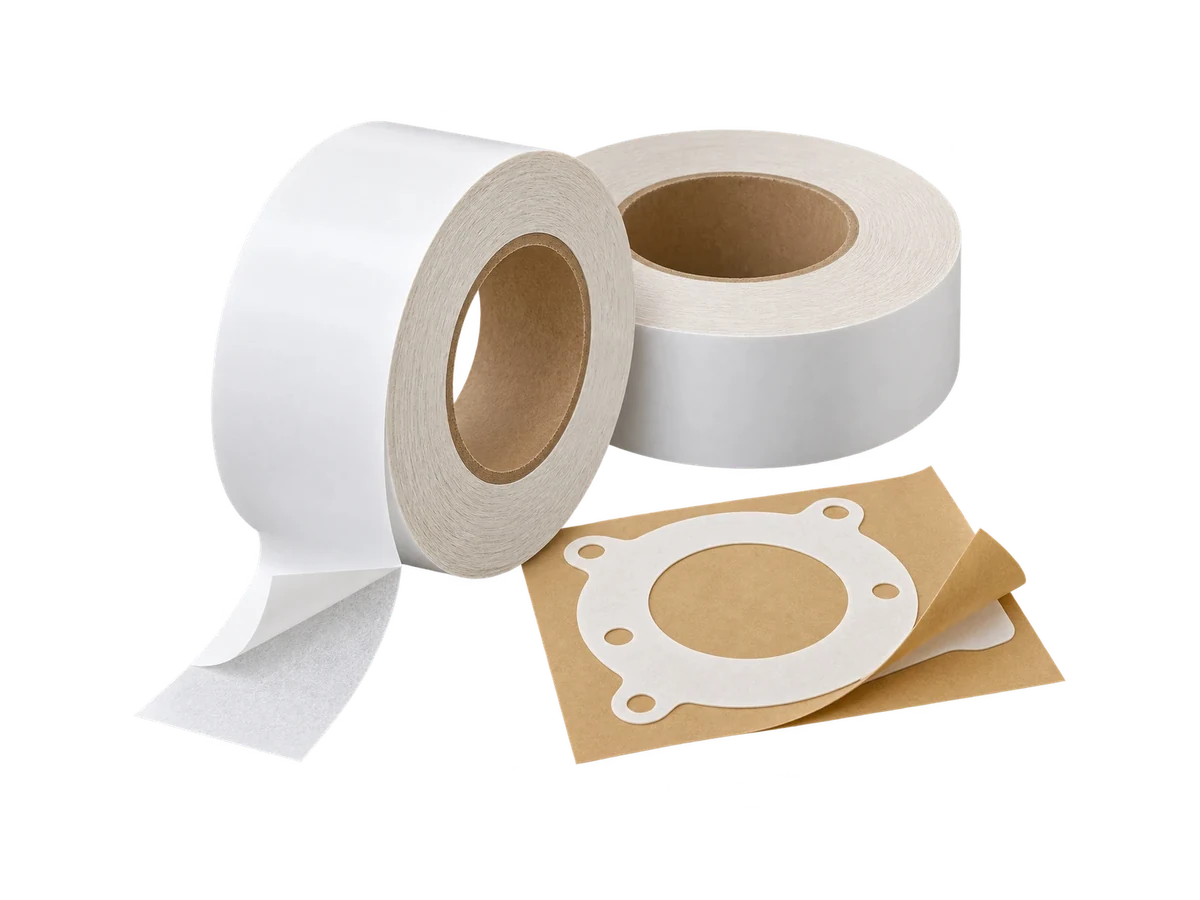
Direct answer. For a 3M 9448A alternative, match the carrier, adhesive system on each face, total thickness and liner to the actual substrates and conversion process; do not approve a substitute from thickness or a supplier cross-reference alone. 3M describes 9448A as a 0.15 mm double-coated tissue tape with medium-firm acrylic adhesive and a polycoated kraft liner. Those are reference construction details, not a blanket performance guarantee.
The search phrase “3M 9448A alternative” can lead to catalog cross-references, but the deciding question is whether the candidate makes the same converted part and bond on your actual materials.
The Broadya tissue tape range is a product-family overview; it does not establish equivalence to 3M 9448A.
Start with the construction, not the cross-reference
The 3M 9448A product page describes a tissue carrier with medium-firm acrylic adhesive and a PCK liner. The 3M technical data sheet gives product-specific construction and application information. Verify the current regional data sheet for the exact code you buy; do not infer that a listed total caliper reveals each adhesive face or the carrier tolerance.
An alternate should be described by carrier family and basis, adhesive chemistry and coat on each side, total thickness and tolerance, liner type, roll direction and available widths. If the part needs a liner that releases cleanly in an automatic pick-and-place or die-cut process, liner behavior is a functional specification, not a packaging detail.
Map both interfaces and the converting route
List both adherends, coatings, surface energy concerns, texture and any porous foam or film that the tissue carrier will reinforce. The tissue carrier can add dimensional stability to a foam or film and improve handling in slitting and die-cutting. This can make a carrier construction easier to process than a transfer adhesive, but it does not guarantee clean stripping or registered placement on every die.
For a foam laminate, include foam density, compression, surface skin and whether adhesive must anchor into a porous or low-strength surface. For film lamination, record film treatment, web tension and unwind direction. State the die shape, minimum feature, matrix removal, liner support, roll width, splice policy and line speed. A tape that bonds well by hand can still fail through edge lift, adhesive ooze or liner tear during conversion.
Compare the bond on the actual substrate pair
The 9448A TDS lists test results under stated substrates and methods. Treat these as that product’s reference data, not a head-to-head comparison with an alternate whose test uses another adherend or dwell. For each critical face, compare the same substrate grade and finish, cleaning procedure, application pressure, temperature, dwell and test method. Record failure mode as well as peak force.
If the alternate is intended to replace a 9448A die-cut part, test finished parts after the actual converting route. Inspect registration, liner release, matrix pick-up, edge quality, adhesive transfer and part handling. Then bond the part to production-representative substrates and apply the customer-defined acceptance test. The carrier and adhesive faces can be differentially stressed by peel and conversion, so roll-level data cannot replace the converted-part trial.
Set a pass rule before the sample trial
The converter, engineer and buyer should agree what “equivalent” means for the part: minimum bond or peel result on each interface, acceptable failure mode, dimensional stability, liner release, die-cut cleanliness and lot-to-lot tolerance. Define conditioning, sample count and re-test triggers before reviewing results. Keep the 3M grade as a control if continuity matters, and label each candidate by supplier lot and construction revision.
Compare trial parts using the actual substrate pair, dwell, converting settings and acceptance criteria; a datasheet value from another substrate is not an equivalence result. If any material, liner or test condition changes, reopen the qualification decision instead of carrying approval forward by name.
Frequently asked questions
Does a 0.15 mm tape automatically match 9448A?
No. Total thickness alone does not identify carrier, adhesive coat weight, liner, tolerance or performance on the two target surfaces.
Can one peel value prove an alternate is equivalent?
No. Compare the same substrate, conditioning, dwell and test method, then validate the actual converted part and assembly.
Next step
For a candidate review, send both adherends, foam or film details, the converted-part drawing, liner requirement, converting route, annual volume and the acceptance test. Treat any proposed alternate as unqualified until the representative converted part passes the agreed trial.
Discuss your application
Tell us the substrate, the joint and the service conditions. We reply with what fits and what does not.