
BUYER'S GUIDE · PET DOUBLE-SIDED TAPE
What should a PET double-sided tape RFQ include for custom converted parts?
A useful PET double-sided tape RFQ for a custom converted part should define the bond, part geometry, liner, supply format, and sample approval process. The supplied catalogue lists PET tape from 30 to 205 microns, several model thicknesses, three liner options, and 1040 mm and 1240 mm master widths.
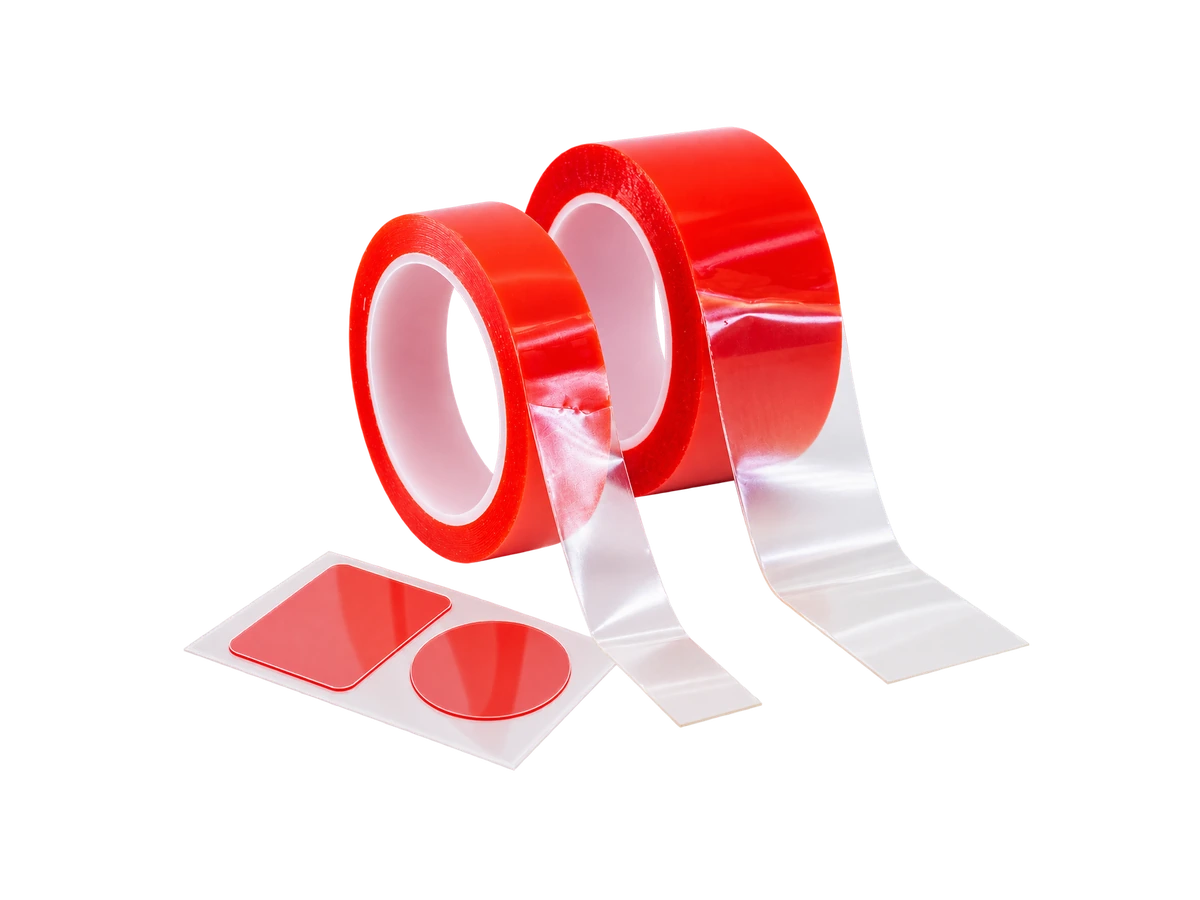
A useful PET double-sided tape RFQ for a custom converted part should define the bond, part geometry, liner, supply format, and sample approval process. The supplied catalogue lists PET tape from 30 to 205 microns, several model thicknesses, three liner options, and 1040 mm and 1240 mm master widths. Those details help frame the request, but the buyer must still confirm finished dimensions and product availability with the supplier.
1. Describe the application and materials
State what the converted part will join and identify both substrates. Include grade, coating, surface finish, texture, and any surface treatment. Attach a drawing or CAD file that shows the bond area, keep-out zones, holes, corners, tabs, and placement tolerance. If the part is visible, identify the cosmetic inspection area. For current constructions and listed applications, see the Double Sided PET Tape product page.
Describe the assembly’s function and loading. If the joint sees heat, humidity, UV, chemicals, or mechanical load, define the real project condition and required test. Do not present a target value as an existing product capability.
2. Specify tape construction and thickness
The PET catalogue lists BY6983G (30 μm), BY6972G (50 μm), BY6980G (80 μm), BY6982G (100 μm), BY6928G (125 μm), BY6967G (160 μm), and BY6965G (205 μm). If a model is known, name it; otherwise provide the stack-up, gap, and tolerance so the supplier can propose a candidate. Ask the supplier to identify the exact construction and supporting documentation. For broader model and specification context, read the PET Tape: Specs, Uses & Selection.
Avoid using vague descriptions such as “thin,” “strong,” or “high temperature” without a measurable requirement and a test method. If the product is still being evaluated, label the thickness as a target for sampling rather than an approved specification.
3. Define the converted format
Provide finished width, length, shape, dimensional tolerance, roll or sheet presentation, and quantity per roll or sheet. For rolls, specify core diameter, maximum outside diameter, winding direction, and packaging. For die-cut parts, provide the drawing revision, pitch, web direction, carrier requirements, and waste-removal expectations.
The catalogue lists white paper, MOPP red film, and yellow grid paper liners. State a preference and explain whether the process needs a tab, visual registration aid, or machine-compatible presentation. Ask the supplier to confirm availability for the proposed model and format.
Match the part geometry and roll or liner format to the listed PET tape constructions, then review the PET tape selection guide before requesting a quote or sample.
4. Explain production and approval requirements
Include application equipment, placement method, pressure, dwell, line speed if relevant, cleaning, operator handling, and assembly sequence. Describe how samples will be evaluated, who approves them, and what constitutes a pass. If the buyer needs reports, list each report by requirement and identify the applicable product scope.
Request a sample that matches the intended conversion. A full-width roll or hand-cut strip may not represent the die-cut part or automated process. Plan enough samples to cover setup, inspection, and repeat trials.
5. Separate commercial assumptions from technical facts
State estimated annual volume, pilot quantity, target delivery window, and packaging needs as buyer requirements. Ask the supplier to confirm MOQ, lead time, and price in the quotation; these values are not established by the PET product catalogue entry. Do not assume a buyer inquiry’s requested dimensions are an available standard item.
For compliance, request the applicable declaration or report and confirm product identity and scope. A catalogue note or report for another construction should not be treated as automatic approval.
Copy-ready RFQ template
Application: ____. Substrate A/B and finish: ____. Drawing/revision: ____. Bond area and load: ____. PET model or thickness target: ____. Finished width/shape/tolerance: ____. Liner: ____. Roll/sheet/core/winding: ____. Application equipment and process: ____. Environmental profile: ____. Sample quantity and acceptance criteria: ____. Required documents: ____. Pilot and annual volume: ____.
This information gives the supplier a clear basis for a candidate quote and sample plan. Final product approval should follow review of the exact construction and successful evaluation on representative parts.
RFQ review before sending
Before the request goes to suppliers, have engineering check the drawing and acceptance criteria, purchasing check the commercial fields, and quality check the document requirements. Confirm that the requested product family is PET double-sided tape and that any special color, liner, or converted geometry is described without relying on shorthand. Remove customer-sensitive details from public examples and keep the RFQ’s project identity in the approved purchasing channel.
When quotations return, compare like with like. Record model, thickness, liner, dimensions, core, packaging, MOQ, lead time, price basis, and any deviations in separate fields. A lower price for a different construction or roll format is not a direct equivalent. Ask the supplier to list exceptions rather than burying them in general notes.
Finally, link the chosen quotation to the sample approval. Commercial acceptance does not replace technical qualification, and technical approval does not automatically confirm price, MOQ, or delivery terms. With those details ready, Request a PET tape quote or sample.
Discuss your PET tape application
Share the substrate pair, bond-line dimensions, assembly conditions and target volume so our team can review a suitable PET tape construction and sample format.