
BUYER'S GUIDE · PET DOUBLE-SIDED TAPE
How should buyers review temperature claims for PET double-sided tape?
Temperature statements in a catalogue need context before they can be used in a product specification. The supplied PET catalogue lists a temperature capability of 150°C, but that single statement does not describe a complete test method, exposure duration, load, substrate pair, or application condition.
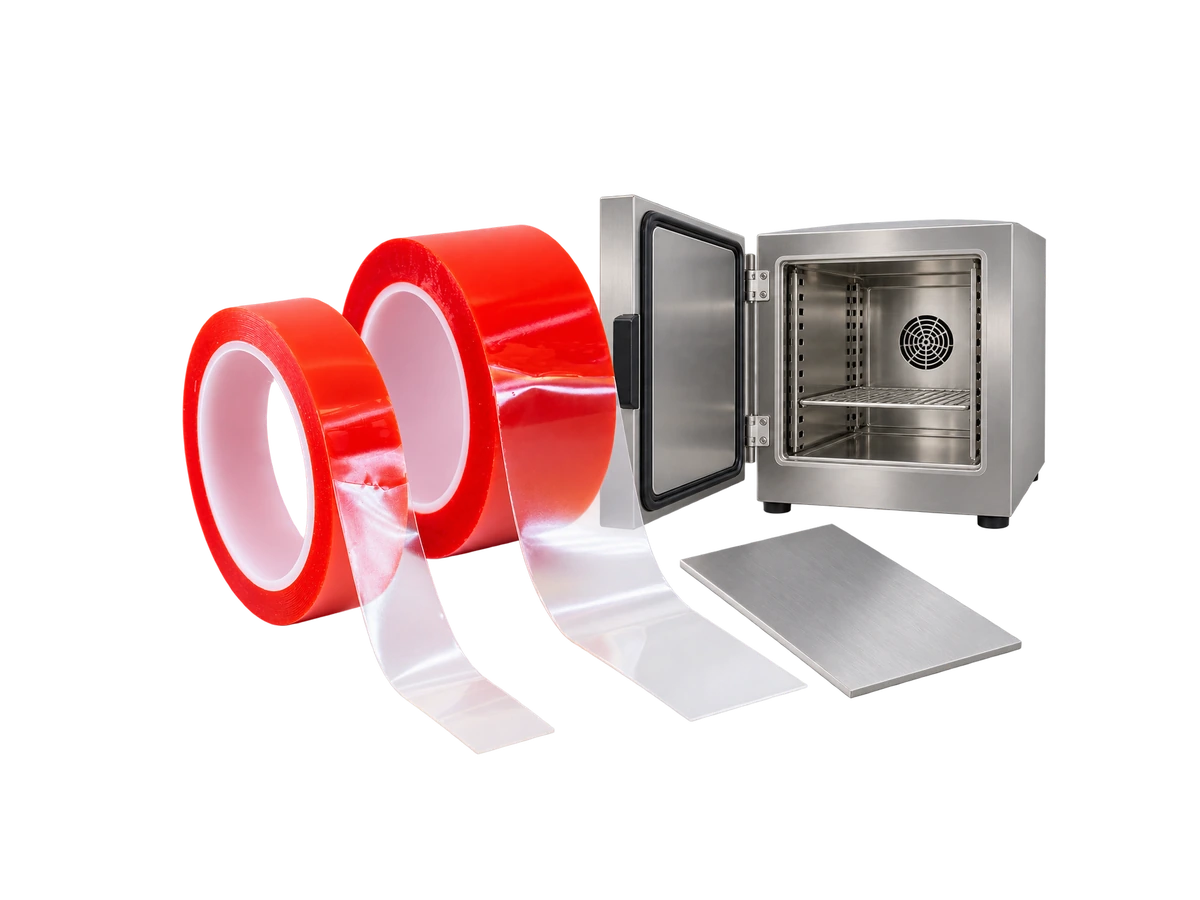
Temperature statements in a catalogue need context before they can be used in a product specification. The supplied PET catalogue lists a temperature capability of 150°C, but that single statement does not describe a complete test method, exposure duration, load, substrate pair, or application condition. Buyers should verify the documentation and test the intended assembly before treating the value as a design limit. For broader model and specification context, read the PET Tape: Specs, Uses & Selection.
Ask what the listed value represents
Request the applicable technical data or test report and ask what the 150°C statement means. Is it a short exposure, continuous service, a test on a particular substrate, or a result under a specified load? The catalogue entry by itself does not answer those questions. If no scoped evidence is available, retain the value as a catalogue statement that needs clarification.
Also confirm which model and construction the document covers. The PET family lists models from 30 to 205 microns. A result for one construction should not automatically be assigned to every thickness, liner, lot, or converted part unless the supplier confirms that scope.
Define the real thermal profile
Describe the assembly’s actual temperature exposure: ramp rate, peak temperature, dwell, number of cycles, cooling period, humidity, load, and whether exposure occurs during manufacturing or service. State whether the joint carries static, peel, shear, or other loads during the exposure. These details help determine whether the supplier’s documentation is relevant.
Include the full component stack and substrate surface conditions. Paint, coatings, plastic grades, and surface preparation can affect the result. A tape-only statement cannot establish the outcome of a specific assembled device or part.
Build a representative validation plan
Prepare assemblies from production-representative components using the planned cleaning, application pressure, dwell, and fixture. Record the tape model, lot, thickness, liner, and sample dimensions. Follow the buyer’s approved conditioning protocol and define pass/fail criteria before testing.
Inspect the joint before and after exposure. Record displacement, edge lift, residue, adhesive transfer, substrate damage, and the actual failure location. If the project needs a numerical result, use the specified test method and document equipment, calibration, sample count, and deviations. Do not substitute an informal hot-plate demonstration for the required qualification method.
Compare the exact candidate with the PET tape construction details and record the evidence boundary described in the PET tape selection guide before repeating any temperature statement.
Keep compliance and temperature evidence separate
The PET catalogue also contains a RoHS statement. That is a separate documentation topic and should not be used to support temperature performance. Ask for each report or declaration by name and confirm its scope, product identity, revision, and validity for the purchasing requirement. For current constructions and listed applications, see the Double Sided PET Tape product page.
When a buyer needs regulatory or customer-specific approval, route the document through the designated quality or compliance reviewer. Do not publish a broad certification claim based only on an internal catalogue note.
Questions for a supplier
Ask: What test method supports the listed value? What was the exposure duration? Which tape model and substrates were tested? Was the joint under load? Does the result apply to the requested liner and conversion? Are there limitations on temperature cycling or post-exposure performance? What additional sample testing is recommended?
Request written answers and the supporting document where available. If an answer is unknown, record it as an open item rather than filling the gap with an assumption.
Approval wording
Until the evidence is reviewed, use careful language such as “the catalogue lists a 150°C temperature capability; applicability to the target construction and exposure profile requires confirmation.” Do not describe it as a universal continuous-use rating or guarantee.
A disciplined document review lets buyers use catalogue information without overstating what it proves. Final approval should connect the exact product construction to the actual application and test record.
Example of a disciplined claim review
A buyer’s internal note may say, “The supplier catalogue lists 150°C; confirm whether this applies to our 100 μm construction for two thermal cycles under load.” That wording preserves the source and exposes the unanswered scope questions. A released product statement such as “this tape is rated for 150°C in all assemblies” would go beyond the information available in the catalogue entry.
Apply the same discipline to supplier presentations, sample labels, and product pages. Keep the original statement, document identifier, product revision, and reviewer decision together. If the underlying test report later becomes available, update the evidence record and determine whether it supports a narrower or broader statement.
If the project has no defined thermal test yet, engineering should set the method and acceptance criteria before qualification. A peak temperature alone is not a complete exposure profile.
Record the approval boundary
A reviewer may approve an article’s wording while keeping the underlying product rating on hold. These are separate decisions: editorial approval does not certify a technical claim. If the test method and report are still unavailable, retain that limitation in the article and route the rating question to the product or quality owner. Update the page only after the supporting evidence is reviewed and tied to the exact construction. With those details ready, Request a PET tape quote or sample.
Discuss your PET tape application
Share the substrate pair, bond-line dimensions, assembly conditions and target volume so our team can review a suitable PET tape construction and sample format.