
BUYER'S GUIDE · PET DOUBLE-SIDED TAPE
How should buyers evaluate PET double-sided tape for plastic-film splicing?
The supplied PET catalogue lists plastic-film joining among its application areas. A buyer considering PET double-sided tape for a film splice should specify both films, the splice geometry, web handling process, and acceptance criteria.
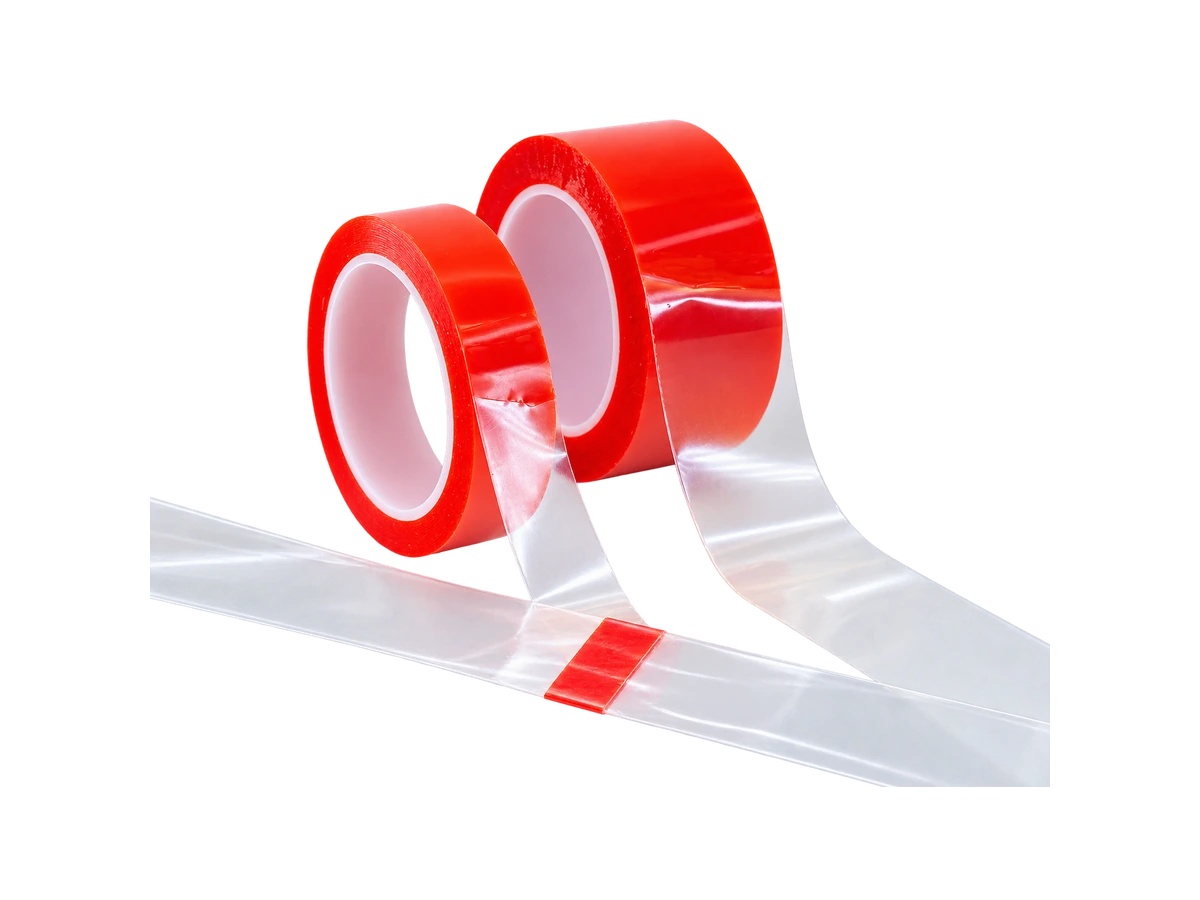
The supplied PET catalogue lists plastic-film joining among its application areas. A buyer considering PET double-sided tape for a film splice should specify both films, the splice geometry, web handling process, and acceptance criteria. A catalogue application listing is a starting point for discussion; it does not establish compatibility with every film resin, coating, additive package, or converting process. For broader model and specification context, read the PET Tape: Specs, Uses & Selection.
Identify both films and the splice design
Record the film material, thickness, surface treatment, print or coating, and which side will contact the tape. If the film supplier or grade can change, include that information because surface conditions may vary. Provide a drawing showing overlap, splice width, direction of web travel, and whether the joint will pass through rollers or other equipment.
Clarify whether the splice is intended for permanent joining, temporary process handling, or another function. Note the tension and direction the joint may experience during production. These details define what the sample must demonstrate; they should not be replaced by a generic request for “strong adhesion.”
Select a candidate construction carefully
The product entry describes a PET film carrier with oil-based adhesive and lists thicknesses from 30 to 205 microns. Listed models are BY6983G (30 μm), BY6972G (50 μm), BY6980G (80 μm), BY6982G (100 μm), BY6928G (125 μm), BY6967G (160 μm), and BY6965G (205 μm). Use this as a candidate range only. The supplier should confirm which construction is available for the specific film pair and splice format. For current constructions and listed applications, see the Double Sided PET Tape product page.
Do not assume that thicker tape necessarily produces a more reliable splice. Consider how the carrier and adhesive affect total stack height, roller passage, edge profile, and converting tolerance. Ask whether a narrow slit or shaped part is feasible and confirm the actual delivered dimensions.
Plan roll and liner details
The catalogue lists white paper, MOPP red film, and yellow grid paper liners, plus master widths of 1040 mm and 1240 mm. A film-processing line may have specific requirements for finished slit width, roll length, core, outside diameter, winding direction, and unwind orientation. State these explicitly rather than assuming the master roll listing determines the finished supply format.
Describe how the operator will position the splice and remove the liner. If placement occurs on a moving web, explain the fixture or splice table and required handling sequence. A converted sample should represent the intended width and liner so that the trial reflects real operation.
Confirm the selected tape construction against the PET tape product details, then check whether its roll or liner format fits the process described in the PET tape selection guide.
Run a representative splice trial
Use production-representative film samples and the planned cleaning, pressure, overlap, and dwell. Record web speed or manual handling steps where relevant. Inspect initial placement, wrinkles, bubbles, adhesive transfer, edge lifting, splice thickness, and any snagging as the joint passes through the process equipment.
After the initial trial, evaluate the splice under the buyer’s actual process conditions. Define whether the joint must withstand a particular downstream step, and establish the pass/fail criteria before testing. If the splice fails, document whether the issue began at the film surface, adhesive interface, edge, or converting geometry. Change one factor per subsequent trial when possible.
Keep claims and requirements separate
A buyer may have target values for line speed, tension, temperature, or splice life. These are requirements to evaluate, not facts about the tape. Ask the supplier which properties are documented for the exact model and which need joint testing. Do not turn a catalogue statement about an application into a guarantee for a specific film web.
If compliance paperwork is required, request the applicable product documents and verify their scope. A compliance record does not establish the mechanical performance of the splice under production conditions.
Information to include in the RFQ
Provide both film grades and thicknesses, surface treatments, printed or coated sides, splice drawing, overlap, finished tape width, roll format, liner, core, process speed, equipment, environmental conditions, target quantity, and acceptance method. Attach representative samples when possible and identify any supplier confidentiality requirements.
With this information, the supplier can propose a PET sample for a controlled trial. The buyer can then decide from the actual film pair and process whether that construction belongs in the production specification.
Questions for the converting review
Ask the converter to confirm slit-edge quality, roll telescoping controls if applicable, splice orientation, and how the liner will be removed at the web station. Request a small converted sample rather than assuming that a master-width listing predicts the finished product. Record the proposed tolerance and inspection method for the delivered format.
During the trial, observe both the adhesive joint and the web path. Does the splice pass through the actual rollers and guides? Does the joint create a step that matters to downstream equipment? Is the liner removed without interrupting the web? These are process questions for the buyer’s line; the catalogue does not provide a universal answer.
If the trial fails, preserve the sample and record the web direction, process stage, and failure location. A clean record lets engineering determine whether the next step is a different width, overlap, thickness, application sequence, or another material candidate. With those details ready, Request a PET tape quote or sample.
Discuss your PET tape application
Share the substrate pair, bond-line dimensions, assembly conditions and target volume so our team can review a suitable PET tape construction and sample format.