
BUYER'S GUIDE · PET DOUBLE-SIDED TAPE
What should buyers check when specifying PET tape for LCD reflective-film assembly?
The PET tape catalogue lists LCD reflective film among its application areas and describes the tape as high transparency. Those statements can help identify a candidate for evaluation, but they do not prove optical suitability in a particular display stack.
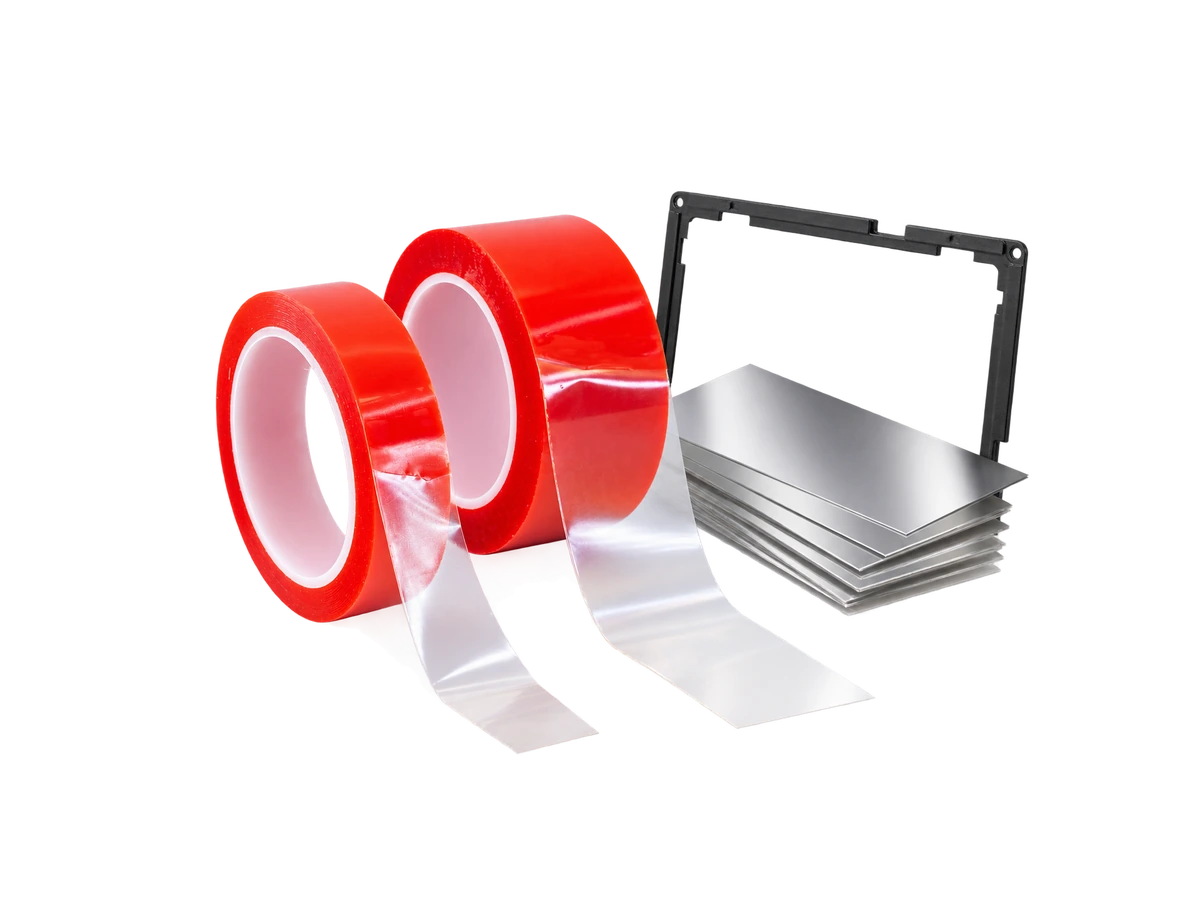
The PET tape catalogue lists LCD reflective film among its application areas and describes the tape as high transparency. Those statements can help identify a candidate for evaluation, but they do not prove optical suitability in a particular display stack. Buyers should define the materials, visible area, geometry, assembly method, and inspection criteria before approving a tape for an LCD reflective-film joint.
Define the interface and optical requirement
Start with a drawing of the full stack: reflective film, frame or carrier, adjacent layers, and any edge that may be visible after assembly. Identify the materials and surface treatments on both sides of the bond. Note whether the adhesive sits inside a concealed perimeter or can enter an optical area. For current constructions and listed applications, see the Double Sided PET Tape product page.
Translate “clear” or “high transparency” into the actual inspection need. Is the requirement about visible edge appearance, haze, color shift, bubbles, particle contamination, or avoiding adhesive intrusion into a viewing area? The catalogue description alone does not define a numerical optical specification, so the buyer should provide the acceptance criteria and request applicable documentation if a measured value is needed.
Control thickness and bond geometry
The PET range in the catalogue is 30–205 microns, with listed models at 30, 50, 80, 100, 125, 160, and 205 microns. The target should be considered alongside the display stack-up, frame flatness, reflective film thickness, and permitted edge position. Do not assume that the thinnest option will automatically deliver the best optical result or that a thicker tape will correct a surface mismatch. For broader model and specification context, read the PET Tape: Specs, Uses & Selection.
Specify the exact tape width, perimeter shape, corner radius, and placement tolerance. If the reflective film uses a narrow border, include a drawing with the optical keep-out zone. Ask for a converted sample that matches the intended geometry instead of judging only a hand-cut strip.
For broader model-range context, compare the PET tape specifications and selection guide with the application notes on the PET tape product page; optical suitability still needs checking in the actual display stack.
Plan application around cleanliness
List the cleaning method, handling controls, application pressure, fixture, dwell, and assembly order. Identify whether the tape is placed on the reflective film or the frame first, and whether an operator can inspect the joint before closing the stack. A repeatable process makes it easier to separate material behavior from contamination or placement errors.
The catalogue lists white paper, MOPP red film, and yellow grid paper liner options. Confirm which liner is available with the selected construction and die-cut format. During a trial, check whether the liner releases without disturbing the film or leaving debris, and whether the converted part stays registered during handling.
Inspect representative assemblies
Prepare samples using production materials and the intended process. Inspect edge alignment, bubbles, wrinkles, adhesive squeeze-out, dust, visible color change, and reflective-film distortion. If optical inspection equipment is part of the buyer’s process, use the same lighting, viewing angle, and measurement setup planned for production.
Condition the samples according to the device’s qualification protocol. After conditioning, repeat visual and dimensional inspection and record any edge lift, displacement, residue, or change in optical appearance. Define pass/fail criteria before starting the trial; avoid inventing acceptance thresholds after seeing the result.
Ask for scoped evidence
Request the product model, construction, thickness, liner, and the documents applicable to that model. If the project needs transparency or other optical measurements, ask whether a report exists for the exact construction and test method. A broad statement such as “high transparency” should not be converted into a numerical optical guarantee.
If compliance is relevant, check that the RoHS documentation applies to the product under evaluation and covers the intended purchasing requirement. Keep compliance evidence separate from optical qualification; one does not establish the other.
LCD reflective-film RFQ checklist
Send the stack drawing, film and frame materials, visible-area limits, bond-line dimensions, thickness target, liner preference, die-cut file, annual volume, assembly method, optical inspection criteria, and conditioning plan. Ask the supplier to mark which answers are documented and which require sample validation.
PET tape may be a candidate for a reflective-film assembly, but the final decision belongs to the tested device stack. A controlled specification protects optical quality and gives the supplier a concrete basis for preparing samples.
Avoid misleading sample comparisons
Optical samples should be labeled with the exact tape model, liner, film revision, frame material, and assembly date. Store at least one unconditioned control if the qualification process includes environmental exposure. Use consistent lighting and camera settings when capturing photographs; automatic exposure can hide or exaggerate edge differences. Photographs help reviewers compare samples but should not replace a required measurement method.
If the trial reveals bubbles or haze, record when the defect appears: during liner removal, immediately after placement, after pressure, or only after conditioning. The timing can help identify whether the next investigation belongs to material selection, cleanliness, application technique, or part design. Avoid changing all of those factors at once.
Before approval, ensure the tested drawing revision matches the production release. A visually acceptable sample assembled from an earlier frame or reflective-film revision should not silently qualify a later design. With those details ready, Request a PET tape quote or sample.
Discuss your PET tape application
Share the substrate pair, bond-line dimensions, assembly conditions and target volume so our team can review a suitable PET tape construction and sample format.