
APPLICATION GUIDE
Foam Tape Bonding: Choose PE, EVA or Acrylic Foam
Five joint situations that help engineers shortlist PE, EVA and acrylic foam tape by gap, load, surface and exposure.
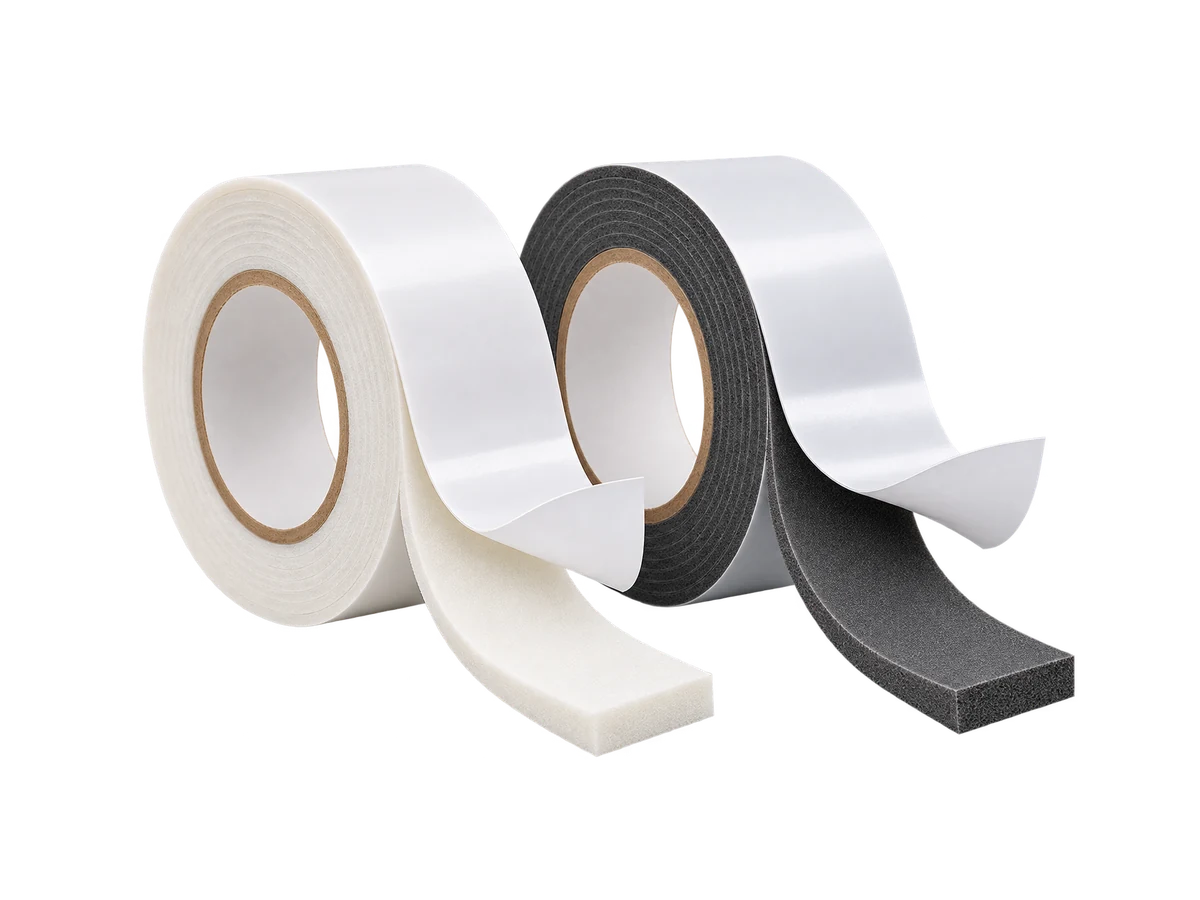
Start with joint geometry, load direction and duration, substrate surface energy and exposure; compare candidate grades under the same test. PE, EVA or acrylic family names alone do not establish suitability. Foam thickness can aid contact and movement accommodation, but cannot rescue an unsuitable adhesive or prove structural strength on its own.
Key takeaways
- Shortlist the foam construction by joint gap, load direction, substrates and exposure rather than by family name alone.
- Check the complete joint geometry and the real production materials.
- Compare candidates under the same assembly and test conditions.
- PE, EVA and acrylic foam families are publicly listed by BROADYA; grade-level performance still needs current matching evidence.
Foam tape is a family of constructions, not a single performance level. BROADYA’s current product catalogue lists double-sided PE, EVA and acrylic foam families. That establishes the page’s product scope, but the catalogue alone does not qualify a particular grade for a particular load, temperature or service life. The five situations below show how to narrow the family before asking for a candidate grade.
1. A small, uneven mounting gap
When two nominally flat parts have local gaps or unevenness, a conformable foam carrier can improve real contact. The first measurement is not the foam’s marketed thickness; it is the maximum and minimum gap across the joint after assembly pressure. A tape too thin may not contact both sides. A tape too thick can alter the finished dimension or expose the joint to peel forces.
3M’s VHB design guide explicitly links thickness selection to substrate rigidity and flatness. Use that as a design principle, then test the proposed BROADYA construction in the actual assembly. PE or EVA foam may be worth screening where cushioning and conformity matter; the adhesive chemistry and the joint load still determine whether the candidate works.
2. A joint under sustained static load
A hanging trim component or panel applies a continuing load. Here the question is not simply whether the tape sticks immediately, but whether the joint maintains position under sustained stress and temperature. Define bonded area, load direction and acceptable displacement. A small overlap, edge loading or a lever arm can turn a nominal shear design into a peel problem.
For this situation, shortlist only grades with relevant long-term load or creep data, then validate the full joint. An acrylic foam construction may be a candidate for demanding mounting, but “acrylic foam” alone is not a strength guarantee. The 3M guide distinguishes static and dynamic loading and requires the bond quantity to reflect viscoelastic and creep behaviour.
3. Dissimilar materials that move differently
Metal and plastic can expand by different amounts. A foam core may accommodate some in-plane differential movement, but the movement must be estimated from the part dimensions and temperature swing. Check what the joint does at its edges and corners, where peel and stress concentration often become decisive. A rigidly constrained assembly can overload even a high-tack tape.
Screen the tape against both substrates, not just the easier surface. If the plastic is low surface energy, require adhesive data on that actual plastic grade or a representative test. Surface preparation and assembly pressure must be controlled. A successful room-temperature peel test does not by itself validate cyclic movement.
4. Cushioning or vibration damping without a primary structural role
Some foam tape jobs aim to prevent rattle, protect a component or hold a lightweight pad. Their acceptance criteria may be compression, recovery, noise and placement stability rather than maximum peel force. tesa’s converter guide describes foam tapes as capable of compensating gaps and damping unwanted noise or vibration. It does not specify how a BROADYA grade will perform in a particular machine.
Define whether the tape carries the component or only locates a separate cushion. That distinction changes the load test and may change the foam family to investigate. PE and EVA families can be compared as candidate carriers, while the actual foam density, adhesive and compression behaviour remain grade-specific.
5. A visible or outdoor bond line
Exterior trim, signage and exposed assemblies introduce UV, weathering, temperature cycles and appearance requirements. A dark bond line may be acceptable behind opaque trim but not behind a transparent part. Outdoor selection therefore starts with the visual requirement and exposure duration, then moves to product-specific weathering and load evidence. Do not equate a water-resistant adhesive with a waterproof enclosure seal.
An acrylic foam grade may deserve priority in a shortlist for this situation, provided its actual data and qualification test support the intended exposure. If the joint is a safety-critical attachment, a simple tape substitution should not proceed without a defined test and release plan.
A decision sheet that avoids false equivalence
For each candidate, record: substrates and surface treatment; joint dimensions; gap range; load direction and duty; maximum, minimum and cyclic temperature; indoor or outdoor exposure; appearance; application pressure and dwell; and the pass/fail method. Compare the candidate grades under the same method and conditions. Peel to steel, shear on a different plastic and a short heat exposure cannot be ranked as if they were the same property.
To start a BROADYA discussion, identify which of the PE, EVA or acrylic foam families you want evaluated and send the joint sketch plus duty conditions. The appropriate construction is the one that passes the joint’s real test, not the one with the highest generic headline number.
Frequently asked questions
How do I choose foam tape thickness for a gap?
Measure the real gap range after assembly pressure. Shortlist a thickness that can contact both surfaces without changing the finished dimension or creating peel stress, then validate it in the actual joint.
Which foam tape is best for outdoor bonding?
There is no universal best family. Compare candidate grades against the actual substrates, weather exposure, load and service duration; an acrylic foam family may be worth screening, but the exact grade still needs evidence and joint testing.
Can foam tape replace a gasket or structural fastener?
There is no automatic substitution. A bonding joint, an environmental seal and a mechanical restraint have different acceptance requirements. Use a tape only when the complete joint passes the specified validation.
What should I include in a foam tape RFQ?
Record the two substrates, surface preparation, gap range, load direction and duty, temperature/environment, assembly pressure and pass/fail method.
Discuss your foam tape application
Share the joint sketch, substrates, gap range and duty conditions so the team can check which foam tape construction may fit.