
CONVERTING & OEM · ROTARY DIE CUTTING
Rotary Die Cutting for Adhesive Tape Parts: When the Process Fits
Screen rotary converting against the part, full material stack, web handling, and acceptance plan.
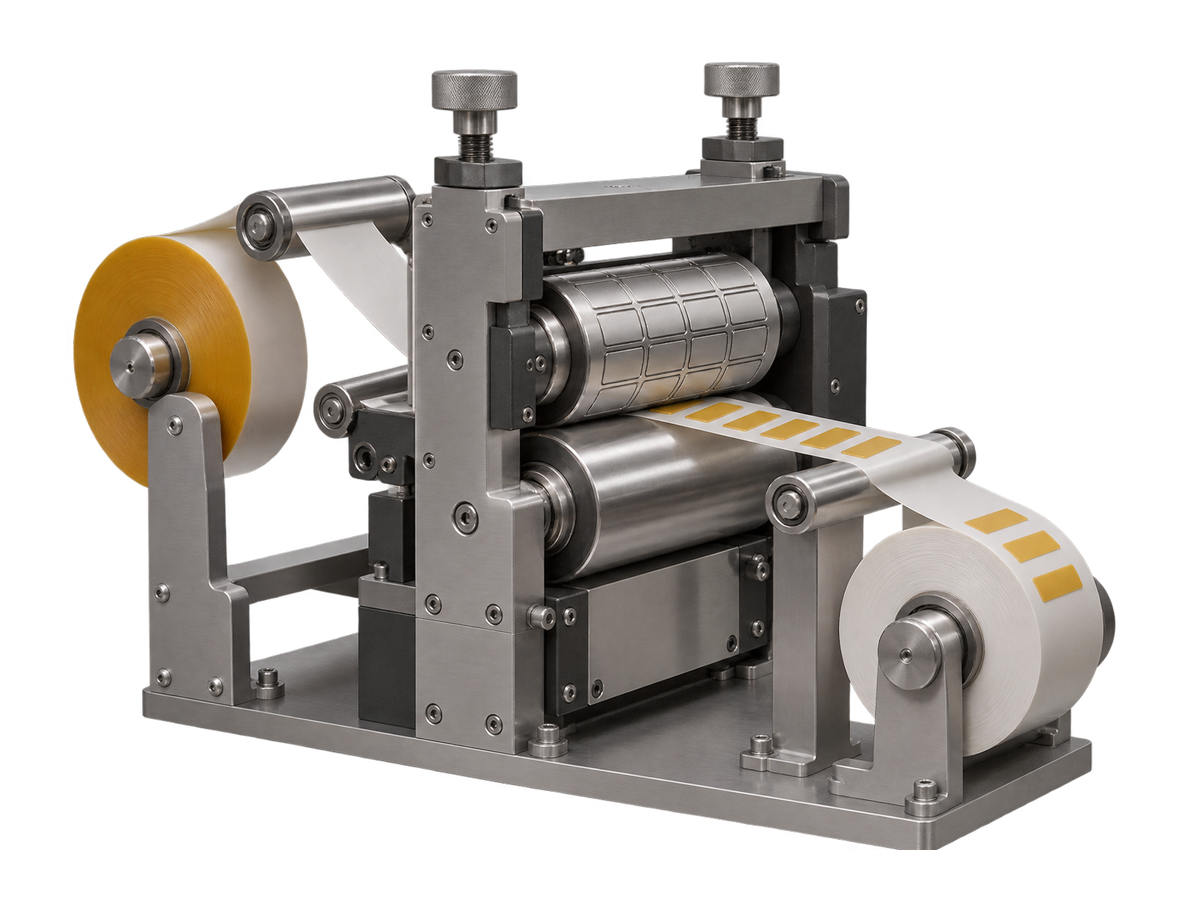
Evaluate rotary die cutting when the job can be processed as a controlled web and the part layout, material stack, registration, waste removal, and expected run pattern suit a rotary setup. Keep flatbed, digital, or other routes in the comparison when prototype flexibility, material thickness, geometry, or project constraints may change the decision. The process name does not establish a universal speed, tolerance, minimum quantity, or cost advantage; the converter must confirm those against the actual construction and drawing. This page uses “rotary die-cutting” as the route label for that evaluation.
To compare routes, give each candidate the same drawing, material stack, acceptance criteria, sample plan, and forecast. Then compare the confirmed setup assumptions against the actual part instead of relying on generic claims about speed, tolerance, or unit cost.
Understand rotary as a web-converting route
In rotary converting, a rotating tool acts on material carried through a web path. That makes the web, liner, and layer stack part of the process discussion, along with the cut geometry. A rotary label on a capability page tells you the converter offers a process; it does not establish that your part will run on it.
The actual route depends on the converter’s equipment and job setup. Strouse, for example, lists rotary alongside flatbed, laser, and digital die cutting in its die-cutting capability overview. JBC’s die-cutting guide discusses route tradeoffs in a wearable-device converting context. Both are supplier-specific references. Their process menus and recommendations should be treated as context, not universal specifications.
BROADYA’s custom converting service page describes die cutting for tapes, foams, films, and functional materials. It does not publish a rotary-specific machine list, tolerance, production rate, minimum quantity, or guaranteed cost advantage. Ask about a route only in the context of the specific part and material stack.
Check the part and material stack against process variables
Before comparing routes, make sure the job definition is complete enough to assess. Review the full construction from top layer to liner: backing or foam, adhesive faces, laminations, release liner, and any removable matrix or tabs. Then map the part to the web and process:
- Web direction and orientation: identify machine direction, cross direction, roll orientation, and which face must be presented to the tool.
- Part layout: show pitch, spacing, nesting, repeat pattern, holes, notches, and the dimensions that control fit or function.
- Registration: identify the datum or reference that controls the cut position relative to print, liner, or another laminated layer.
- Waste and matrix handling: state whether surrounding material must be stripped, retained, or separated without disturbing the finished part.
- Delivery format: specify roll, sheet, individual pieces, rewind direction, and any orientation needed at the assembly line.
- Acceptance: distinguish drawing requirements from process limits that the converter has not yet confirmed.
These inputs do not prove rotary feasibility; they give a converter something specific to evaluate. Review the full stack, web direction, layout, registration, matrix removal, liner integrity, and finished presentation with the converter. The same reasoning applies to an existing custom die-cut tape drawing—but this article owns the process-route decision, while the drawing guide owns the design information needed to quote a part.
Compare rotary with other routes on one controlled job
Do not compare “rotary” and “flatbed” in the abstract. Ask each candidate route to review the same revision-controlled drawing and complete material stack. Compare the same drawing, stack, critical dimensions, sample plan, delivery format, and forecast; use only converter-confirmed assumptions. A useful comparison keeps the geometry, required dimensions, incoming material, sample quantity, inspection method, finished format, and forecast constant.
| Comparison point | What to ask for each route | Why it changes the decision |
|---|---|---|
| Tooling and setup | Which tool or setup is required, and what changes if the outline or pitch changes? | Revisions can change the cost and schedule assumptions behind a route. |
| Stack and web handling | Can the full stack pass through the proposed process without liner, adhesive, or laminate problems? | A process that cuts one layer may not suit a different completed construction. |
| Registration and critical dimensions | Which values are requested, which are achievable, and how will they be measured? | A requested drawing value is not automatically a confirmed process capability. |
| Waste removal and finished presentation | How is the matrix handled, and how are parts oriented and delivered? | The part must be usable at the next operation, not merely cut to an outline. |
| Commercial assumptions | What run pattern, inspection, material yield, and sample basis underlie the quote? | Compare offers only when their assumptions describe the same job. |
Rotary may be a candidate for a repeat web process; flatbed or digital may remain candidates when the job’s geometry, setup, material, or revision pattern changes the tradeoff. Those are screening hypotheses, not guarantees about volume thresholds or universal process performance. The converter should state which route it recommends for the submitted job and what evidence supports that recommendation.
Turn the chosen process into a verifiable RFQ and sample plan
Put the route discussion into a short, controlled request. Attach the drawing and revision, material stack, web direction, layout, critical dimensions, required finish and liner, delivery format, expected order pattern, and sample acceptance criteria. Ask the converter to separate its confirmed limits from the values that remain targets or require trial validation.
For a sample review, record the material and tool setup, part revision, cut and registration observations, liner integrity, matrix removal, part orientation, and inspection results. Test the finished format at the receiving operation if feeding, peeling, or placement matters. A successful sample on one construction does not establish performance for another stack or process route.
The route decision is ready when the recommended process, its setup assumptions, accepted dimensions, finished presentation, and sample evidence are tied to the same job revision. If the geometry, material stack, forecast, or line interface changes, reopen the comparison instead of carrying the old route forward automatically.
For a project-specific review, BROADYA’s converting overview describes its public tape, foam, and film converting scope. The page does not promise a particular machine route or numeric capability. BROADYA’s PE foam tape range is one relevant product-family reference; the proposed material and converting process still need to be confirmed for the actual drawing.
Frequently asked questions
Is rotary die cutting always faster than flatbed die cutting?
No universal speed claim follows from the process name. A converter’s equipment, setup, material stack, part layout, run pattern, inspection, and finishing steps determine the actual proposal.
Does a rotary process guarantee a tighter tolerance?
No. The drawing tolerance must be reviewed against the exact construction, tool, equipment, and inspection method. Treat requested dimensions as targets until the converter confirms feasibility.
What should I provide when asking about a rotary route?
Send the controlled drawing, full layer stack, web direction, layout and pitch, critical dimensions, matrix and liner requirements, delivery format, forecast, and acceptance criteria. Ask the converter to state its setup and capability assumptions explicitly.
Next step
Share the drawing revision, material stack, web orientation, critical dimensions, planned delivery format, and expected run pattern. Ask which routes are feasible for that exact job and which limits need sample confirmation. This keeps the process recommendation separate from any general-purpose claim about rotary converting.
Discuss your application
Tell us the substrate, the joint and the service conditions. We reply with what fits and what does not.