
ACRYLIC FOAM TAPE · MODEL SELECTION
3M VHB 5952 vs 4910: Choose by Bondline and Substrate
Compare documented construction, appearance and thickness before validating either grade on the real joint.
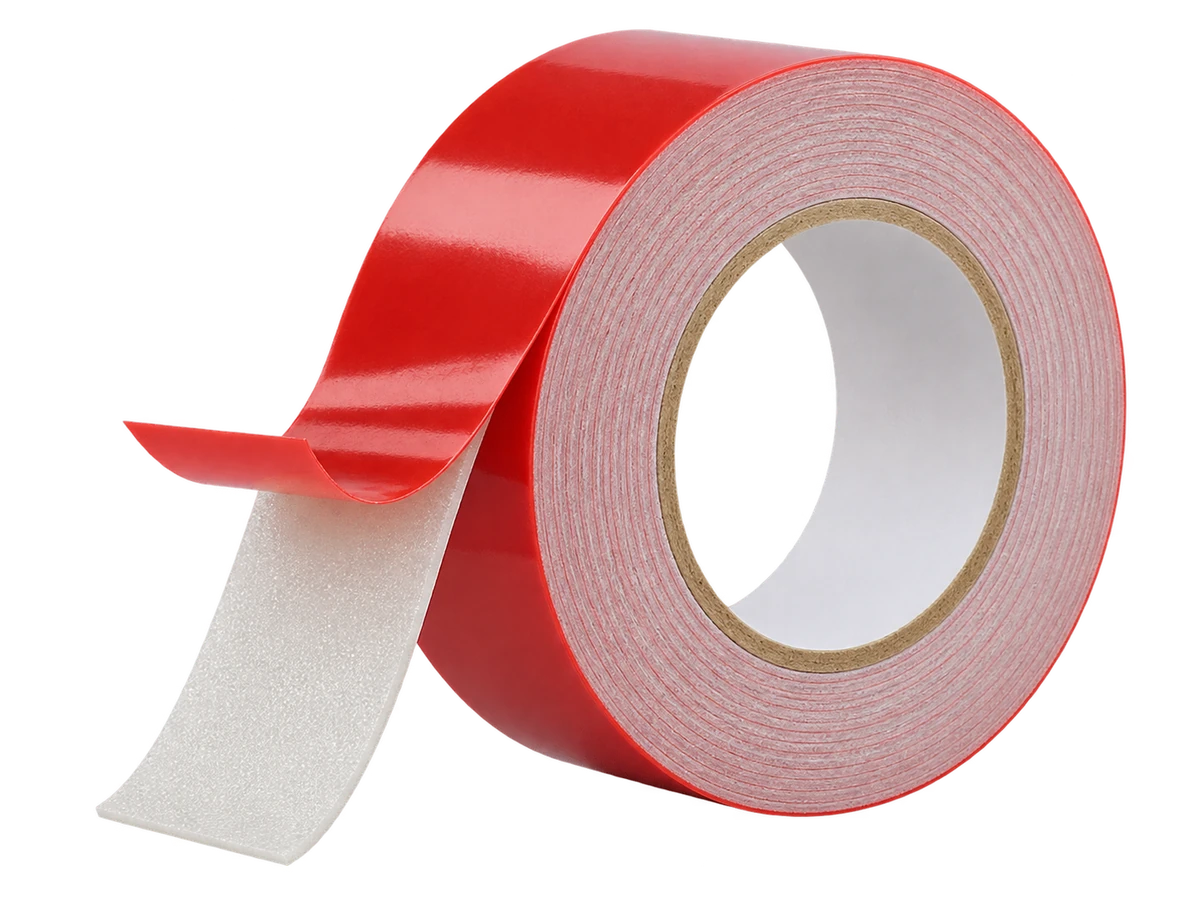
Direct answer. Start with whether the joint must remain visually clear and identify both bonding faces. 3M describes VHB 5952 as a black, modified-acrylic foam tape with a total thickness of 1.1 mm; 4910 is a clear, general-purpose acrylic foam tape at 1.0 mm. These construction differences guide screening. They do not make the grades interchangeable, and the exact assembly still needs evaluation.
A model number is a useful search shortcut, not a complete design specification. Compare the product family, both adhesive interfaces, joint geometry and process before you use either grade as a reference for another tape. For 3M VHB 5952 vs 4910, appearance is a useful first screen, while the joint and substrates determine what must be tested.
What the published constructions establish
3M’s product information for 5952 describes 5952 as a conformable foam-core tape with modified acrylic adhesive. Its documented black appearance and 1.1 mm total applied thickness matter when the bondline is visible, when the part has a dark trim edge, or when the drawing controls the installed gap. 3M VHB 4910 TDS describes 3M VHB 4910 as a clear, general-purpose acrylic foam tape at 1.0 mm. Its transparency is a useful screen when the appearance of a clear joint is part of the design.
For a clear bondline, 4910 is the initial screening direction; where black appearance and the 5952 construction fit, screen 5952. Reverse either choice if geometry, a substrate interface or process validation fails.
These are product-specific facts from 3M’s pages and technical documents. Use the current regional TDS for the exact SKU being purchased; product configurations and documents can vary by region. Typical values in a TDS are not automatically a production specification.
Let the two bond faces decide the next question
List the actual materials and finishes on both sides. “Metal to plastic” is incomplete if one side is powder-coated steel and the other is textured PC/ABS. Record the coating or resin, texture, surface treatment, curvature, mating area and any plasticizer or release-agent concern. For painted components, the paint system and cure state are part of the adhesive interface. Follow a documented preparation process; the 3M 5952 technical data sheet provides surface-preparation guidance for that product family, not approval of this specific joint.
Do not infer that 5952 is suitable for every low-energy plastic or that 4910 is suitable for every transparent plastic. 3M’s family and product guidance can identify the intended screening range, but a substrate name alone cannot predict the bond on a particular coating, texture or molded part. If the two faces differ materially, compare each adhesive interface separately and include the weaker face in the trial.
Compare the joint and process, not only thickness
The 0.1 mm difference between the cited nominal constructions does not tell you whether either tape can fill the actual gap or accommodate the part. The 5952 vs 4910 thickness comparison is only a construction screen, not proof of gap fill. Check the tolerance stack, local curvature, flange width, edge exposure, assembly pressure, application temperature, dwell before handling and service temperature. If the design depends on movement or environmental sealing, define those conditions before a candidate is approved. A clear vs black acrylic foam tape comparison starts with line-of-sight and bondline appearance; surface and assembly fit decide approval.
For an alternate product, request the full construction: foam core, adhesive chemistry on each face, total thickness and tolerance, color, liner, and the applicable peel, shear or dynamic test method. Compare results only when substrates, dwell, temperature, specimen preparation and test methods match. An isolated peel number on stainless steel does not prove performance on an automotive clearcoat or a textured housing.
Use a representative assembly to make the final choice
Prepare production-representative substrates with the intended cleaning and application process. Include the least favorable allowed coating or surface texture, the smallest bond area and the highest expected service exposure. Inspect initial contact and edge wet-out, then test after the specified dwell and conditioning. Record the tape lot, surface lots, application pressure and failure mode so that a future supplier comparison is traceable.
If visual clarity is mandatory, assess the real bondline from the viewing angles and lighting in the finished product; a clear roll does not guarantee an invisible joint. If black color is acceptable, do not select 5952 on color alone: its substrate compatibility and assembly result still need to match the program.
What to include in a comparison request
Send the joint drawing, both substrate and coating descriptions, required color, nominal gap and tolerance, bond area, application process, service exposures, target dimensions and annual volume. Ask for a named construction and test evidence tied to those conditions. Broadya’s Broadya acrylic foam tape range is a product-family overview; it does not claim equivalence to either 3M model.
Frequently asked questions
Does 4910’s clear appearance mean the finished joint will be invisible?
No. Visibility also depends on the substrates, edge geometry, bondline thickness, trapped air, lighting and viewing angle. Inspect the completed assembly.
Can I compare the two products using peel adhesion alone?
Peel can screen a defined interface under a defined method, but the test substrate and conditioning must represent the program. A peel result does not replace the joint’s required shear, dynamic or environmental validation.
Next step
For a like-for-like candidate review, share the two bond faces, the drawing or section view, the visible-edge requirement, application conditions and target order format. Treat any proposed grade as a sample candidate until the production-representative joint passes your acceptance criteria.
Discuss your application
Tell us the substrate, the joint and the service conditions. We reply with what fits and what does not.