
APPLICATION GUIDE · WHEEL WEIGHTS
PE Foam Tape for Wheel Balance Weights: Specify the Interface Before the Tape
Define the coated-rim interface and installation window before choosing a PE foam tape candidate.
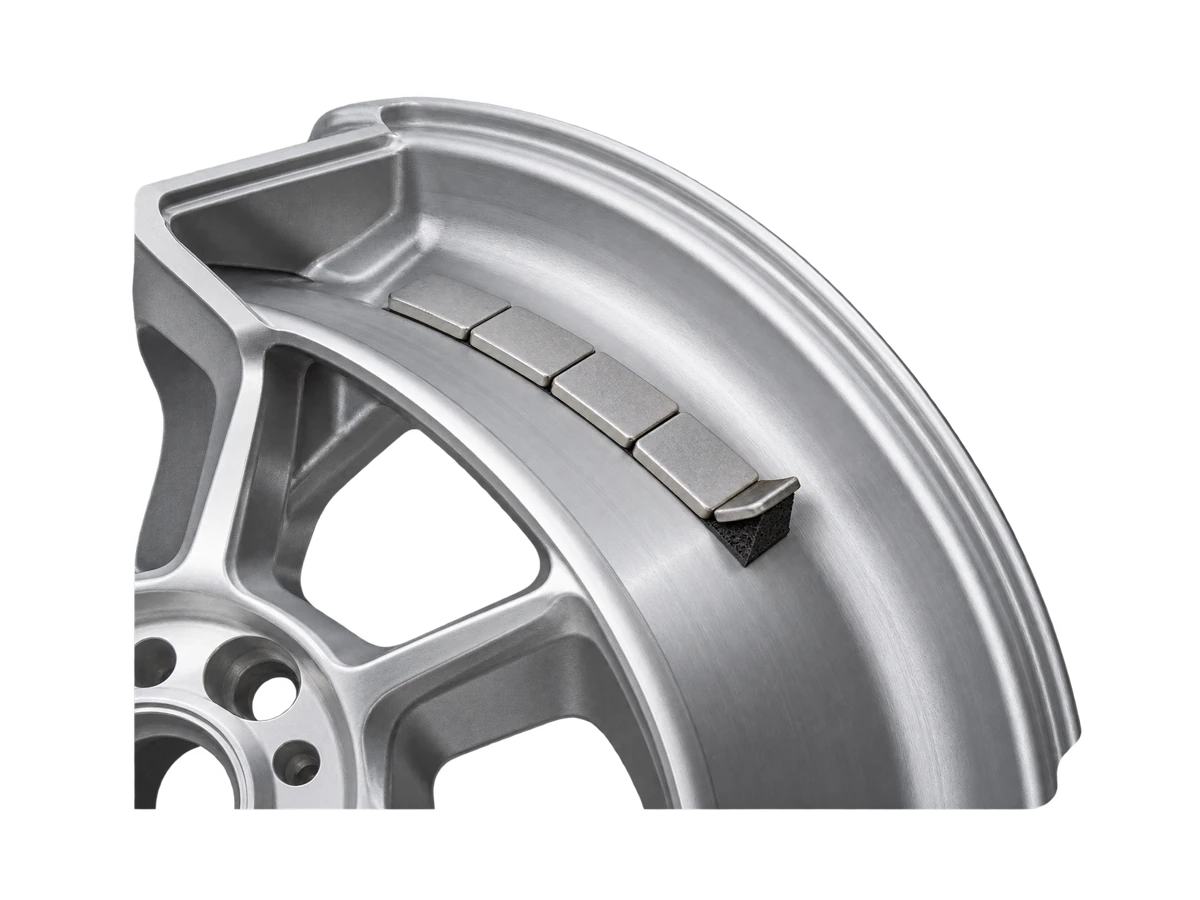
Direct answer. To evaluate PE foam tape for a wheel balance weight, specify the actual interface and installation process before comparing tape grades. A foam thickness or a supplier’s installation instruction alone cannot establish retention for another construction.
Control the actual wheel system before choosing thickness: confirm rim coating and geometry, weight base, surface preparation, temperature, application pressure and wet-out, then validate retention on a representative assembly under the required service conditions. Supplier instructions are process examples, not qualification of a different tape. The acceptable retention and exposure sequence must come from the wheel program.
Map the wheel and weight interface first
The bonding location is a mechanical constraint, not just an area on a drawing. Record the rim’s coating system and the exact landing zone, including its width, radius, local slope, ridges, texture and any interruption under the weight. Specify whether the weight is a rigid segmented bar or a flexible roll, its base coating, segment joints, mass and intended orientation. A candidate that bridges a ridge can have less real adhesive contact than its nominal footprint suggests. 3M’s wheel-weight application guide explicitly calls for location that avoids bridging wheel features.
The geometry and limits in a finished weight maker’s instructions are useful process examples, not transferable pass criteria. WEGMANN’s adhesive-weight guidance sets a maximum 15° axial slope for its system and describes forming the weight to the rim radius before liner removal. If the actual landing zone lies outside a proposed weight system’s permitted geometry, move the location or change the attachment route before comparing tape grades. Do not apply that 15° number as a Broadya tape rating.
Specify the coating and surface state
The rim side is usually a coating, not bare aluminium. Identify its paint or powder-coat family, cure state, surface texture and any release, polish, tire lubricant or previous adhesive residue. Document an approved, coating-compatible cleaner and drying procedure. Record how cleanliness is checked at the actual station; an apparently clean test coupon does not represent a wheel that has passed through tire fitting.
For a replacement-weight process, remove old adhesive before judging the new bond. A Bentley technical service bulletin warns that remaining balance-weight adhesive can prevent full contact and allow detachment. That is a concrete reason to include a previously serviced rim in the trial if the program covers replacement weights; it is not a Broadya performance result.
WEGMANN’s instructions require a dry rim free of grease, silicone, dust and old adhesive; its example uses a paint-compatible cleaner such as 70% isopropanol. Its stated surface-energy threshold belongs to its adhesive-weight system. 3M’s troubleshooting guide separately identifies tire lubricant, skin oil and dust as possible contamination and asks users to verify adhesion to the actual wheel coating. These are reasons to record coating and cleaning conditions, not evidence that a different PE foam tape will meet either supplier’s limits.
Lock the installation window and contact method
Specify the minimum and maximum temperature of the rim, weight and tape at application, not only the room setpoint. Define the time between cleaning and bonding, liner removal method, allowable handling, placement tolerance, pressure tool, pressure direction and dwell before the wheel is handled. Cold parts may conform less well; a cold rim brought into warm air may collect condensation. 3M explains both risks in its wheel-weight guide.
Pressure must produce contact across the full weight, especially at the edges. For its own system, 3M describes a 5 psi roller-pressure starting point and an 80% minimum wet-out check with no localized voids. These are 3M process criteria, not generic specifications for PE foam tape. A Broadya candidate needs its own application window and a contact check on the representative coated rim. Record the failure mode when an assembly is removed: clean adhesive release from coating, foam split, adhesive transfer or coating damage point to different problems.
Define the validation assembly and acceptance rule
Use representative wheel, coating and balance-weight assemblies to define retention and environmental tests; installation guidance or peel alone is not proof of in-service retention.
The first screening set should use production-representative wheels and weights, including coating variation, the most difficult approved landing geometry, and the coldest allowed installation condition. Compare repeatable assemblies made by the intended process with a controlled reference. Measure initial contact and retention after the specified dwell, then repeat after the service exposures selected by the wheel program. These may include temperature cycling, moisture, road chemicals and mechanical handling where applicable; the customer or wheel program must define the actual sequence, duration and pass criteria. Peel on standard steel is a material-screening datum and cannot replace assembly retention on the coated wheel.
Record weight mass and position, tape construction and lot, coating identity and lot, cleaning method, application temperatures, pressure method, dwell, conditioning sequence, retention result and failure mode. A proposed test should be able to reject a candidate that meets a bench peel value but loses contact at a curved edge. If coating damage or unsafe weight release occurs, stop that route and investigate the interface or attachment method before changing only foam thickness.
Interpret “10x” only within a named foam specification
Resolve 10x against the supplier’s foam family, density and tolerance before comparing grades; the multiplier is not a universal PE foam specification.
“10x” is not a universal PE foam density grade. Expansion ratio needs a stated starting material and measurement convention; equal shorthand labels can hide different foam family, density, cell structure and tolerances. Before comparing a “10x” request with another grade, obtain the supplier’s actual density range, thickness and tolerance, foam process, adhesive on each side and test method. The number should not be converted into a wheel-retention claim.
For context, AMK Tape’s wheel-balance PE foam tape page lists one PE foam and acrylic adhesive construction for this application. That vendor listing shows an application example, not an independent qualification of Broadya’s model or the meaning of a buyer’s “10x.” Broadya’s current PE foam tape product range describes available family options; it does not establish wheel-weight-specific retention.
What to put in the evaluation specification
Release a candidate for trial only when the drawing and process sheet identify the wheel and coating, landing-zone geometry, weight base and mass, tape construction and dimensions, cleaning and drying, temperature and pressure window, dwell, service exposures and acceptance criteria. If a field is unknown, mark it as an open test input. This gives sourcing a comparable request and gives quality a reproducible reason to accept or reject the assembly. Send those conditions with the target volume and sample dimensions when discussing a PE foam tape candidate; wheel-weight suitability remains subject to application-specific validation.
Discuss your wheel-weight application
Share the rim coating and landing geometry, weight base and mass, installation process, service duty, and target volume.