
APPLICATION GUIDE · PE FOAM TAPE
PE Foam Tape for Wood Furniture Bonding: Qualifying the Joint
A practical way to screen the contacted wood finish, moisture exposure, bond area, and load path before qualifying a 1.0 mm tape joint.
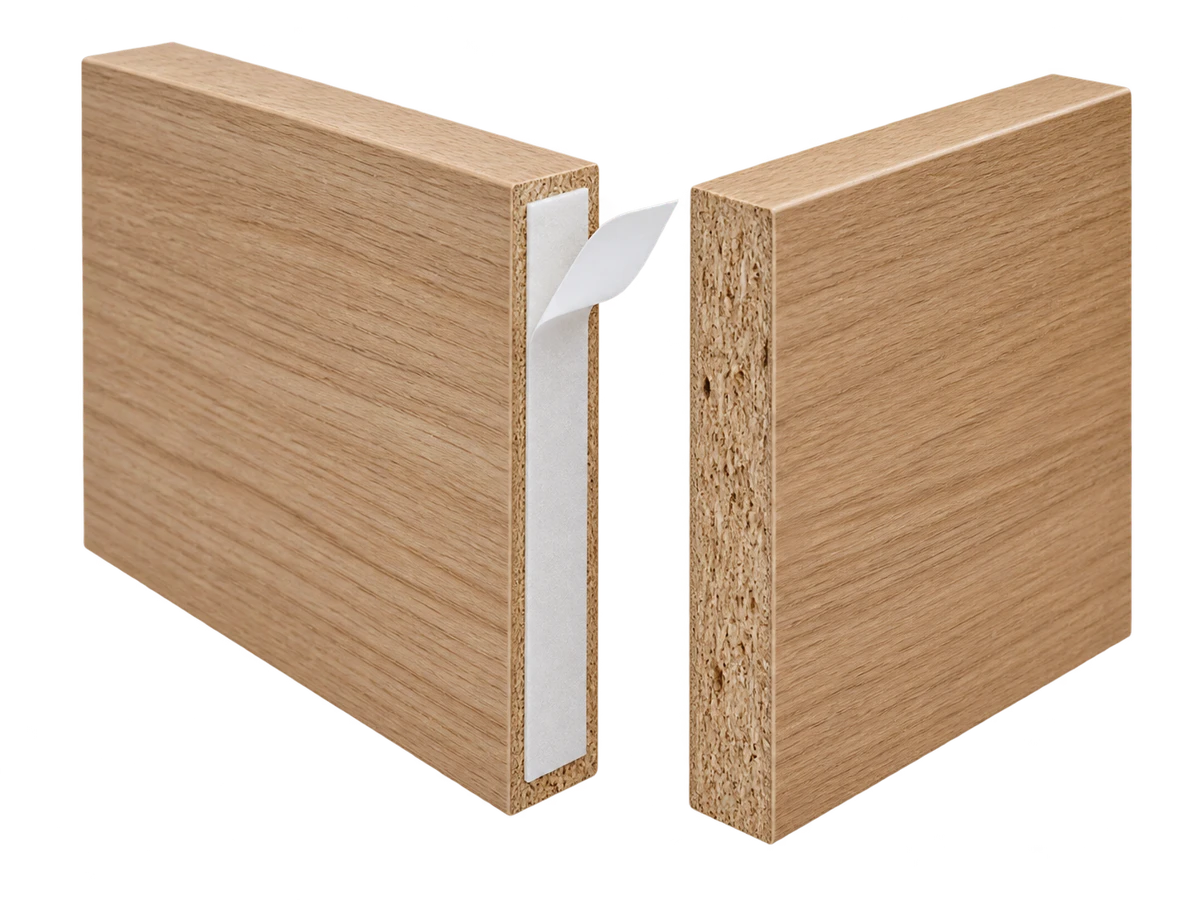
A 1.0 mm double-sided PE foam tape is a candidate for a furniture joint only after the actual contact faces and load path are defined. Raw porous wood, a painted face, and a laminate are different bonding surfaces. Moisture can alter the surface or the underlying wood, while a free edge or levered component can turn an apparently broad bond into a concentrated peel load. Thickness alone cannot establish holding performance. This guide explains how to narrow the candidate and design a representative test; it does not assign a load rating to Broadya tape.
Start with the face the adhesive actually touches
The adhesive may contact unfinished wood fibers, a sealed coating, a decorative film, or a laminate. Treat these as separate substrates, even when all parts are called “wood furniture.” 3M’s surface-preparation guidance says porous or fibered wood and particleboard generally need a sealed, unified surface for tape bonding. That is a reason to compare an unsealed part against the intended sealed production part, not proof that any particular sealant and tape combination works.
A coating creates a new bonding interface: the adhesive must hold to the finish, and the finish must hold to the wood. On a painted or laminated face, the tape can remain attached to the finish while the finish separates from the wood. A passing tape peel result on a metal test panel would miss this failure path. Record the coating or laminate system, its cure state, and whether the bond line crosses exposed edges. The Broadya PE foam tape range is a starting point for discussing constructions; its public page does not establish performance for this wood joint.
Map the area and the force before comparing tapes
Mark the actual contact footprint, interruptions, free edges, and any stand-off that gives the attached part leverage. A larger nominal area helps only if the surfaces make contact and the load reaches that area. 3M’s joint-design guidance distinguishes distributed shear or tension from edge-concentrated peel and cleavage. If an overhanging trim, a flexible panel, or repeated opening creates sustained edge lift, change the geometry, add mechanical support, or evaluate another joining method before selecting by tape thickness.
Specify whether the service load is parallel to the bond plane, normal to it, or opening one edge. Then record its direction, duration, and the bonded area on the real part. ASTM D3654/D3654M is a shear-adhesion method under constant parallel load; ASTM D3330/D3330M addresses peel adhesion. Neither standard result on a reference panel is a furniture-joint capacity by itself. Test the assembled part where the critical load is a combination of directions.
Let moisture and production condition define the test
Moisture is a joint condition, not a single tape property. Wood moisture, ambient humidity, cleaning residue, coating cure, and later wet exposure can change contact or the integrity of the surface beneath the tape. 3M’s guidance notes that bond durability on hydrophilic surfaces can change under high humidity or moisture exposure. Compare specimens assembled under the intended production condition and conditioned for the relevant service exposure. Record the state of both faces before bonding and inspect where failure occurs: adhesive-to-face, coating-to-wood, fiber tear, or foam split.
A short dry-room pull can screen assembly defects, but it does not establish long-term service performance. Do not transfer a mirror-mount certification to a load-bearing wood-to-wood furniture joint: the tested tape, adherends, geometry and failure criterion differ. Define acceptance criteria for the actual furniture component, including visible edge lift and functional displacement, before testing. The result applies to the named tape construction, surfaces, geometry, preparation, and conditioning used in that trial.
Decode the 15x or 20x foam label before comparing quotes
The reported 15x/20x expansion language is supplier-specific until its reference and method are supplied. Ask for the foam family, density and tolerance, cell structure, and whether the multiplier describes raw polymer expansion or a finished carrier. Do not translate either label into a Broadya density or into a relative holding-force claim. A quoted 1.0 mm total tape thickness also needs a stated tolerance and construction, because foam and adhesive layers may differ between offers.
tesa’s furniture mirror-mounting example illustrates why a named tape and named application matter: it concerns tesa 62510 and mirror mounting, not this wood-to-wood joint or a generic PE foam grade. Compare candidate constructions only after the suppliers describe them on the same basis and the actual joint test is defined.
A decision for this joint
Keep a 1.0 mm PE foam tape on the shortlist when the production face is stable and bondable, the tape can contact the designed area, the assembly avoids sustained edge opening, and representative conditioned specimens meet the component’s acceptance criteria. If raw porous wood cannot be sealed consistently, a coating releases, or the geometry concentrates peel at a free edge, resolve that issue before treating tape as a qualified joint. This is a conditional selection path, not a claimed Broadya load capacity.
Next step
For a construction review, provide photos or drawings of both contact faces, the finish or laminate, the bonded footprint, the load direction and duration, moisture or cleaning exposure, target thickness, and the quoted foam definition. Those details let a supplier propose a specific construction for a representative trial. Broadya’s public product page does not establish stock, certification, or furniture-joint performance for the requested construction.
Discuss your furniture joint
Share the contact faces, finish, bond footprint, service load and moisture exposure so a construction can be considered for testing.