
COMPARISONS · FILM CARRIER
PET vs OPP vs PVC Film Carrier: Choose for the Converted Part
Choose a film carrier from the part’s processing and service needs, then verify the finished construction.
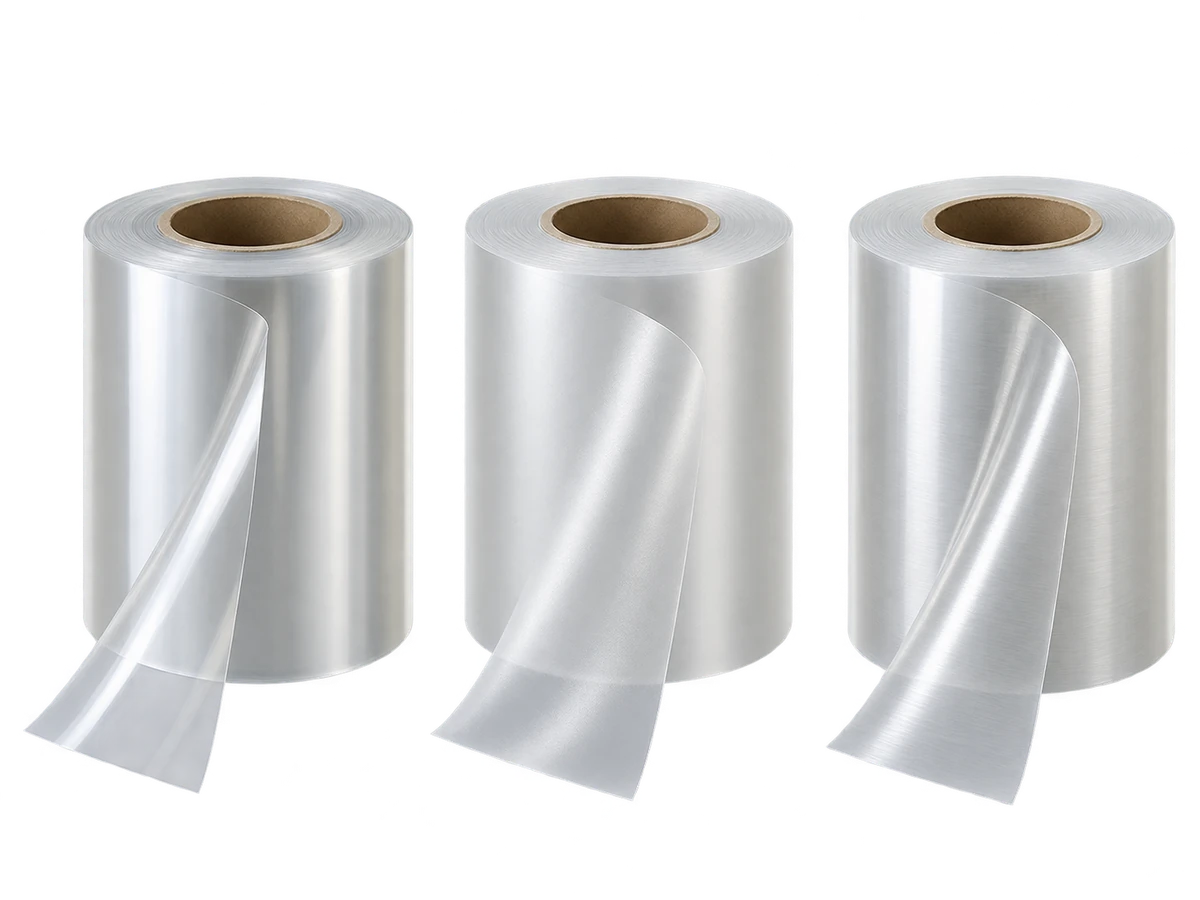
Start with the finished part’s temperature, dimensional stability, flexibility and conversion needs. PET is a useful starting point for thin stable die-cut constructions, PP for suitable flexible film use, and PVC only after specifying rigid or soft grade and plasticizer compatibility. None of these material names alone predicts finished-tape adhesion.
Hold the rest of the tape constant
The carrier is only one layer in a double-coated construction. An apparent PET–OPP–PVC performance difference may come from adhesive, coat weight, film thickness or release liner. Start the comparison from the converted part’s function: must it remain flat through die cutting, bend around a profile, withstand heat, or tolerate a potentially migrating ingredient? tesa’s backing guide distinguishes the film families but does not make every finished tape interchangeable. OPP means oriented polypropylene; a product described only as PP film does not establish its orientation. In tesa 4917, the PP film is the carrier and MOPP is the liner—confusing them would select the wrong layer.
When a thin film must remain dimensionally stable during processing, PET-backed constructions are a plausible starting point; check the actual film grade, thickness and cut performance rather than assuming every PET tape behaves alike.
Flexible PVC can contain migrating plasticizers that affect an adhesive interface, so use an explicit aging/compatibility test for the actual PVC and adhesive rather than extrapolating from rigid PVC. 3M’s flexible-PVC guidance specifically warns about plasticizer migration into some adhesive bonds. Rigid PVC and plasticized flexible PVC must therefore not be treated as one option.
A conditional carrier shortlist
| Candidate | When it deserves a trial | What can reverse the choice |
|---|---|---|
| PET | Film option used for thin double-coated constructions and stable processing. Start here when dimensional handling and thin die-cuts dominate. | A rigid bond line or nonconforming adhesive can disqualify a PET construction. |
| OPP/PP | PP-film double-sided tapes exist, but OPP orientation and the release liner are separate specifications. Investigate PP constructions only after identifying the actual carrier grade. | Do not infer heat or cut stability from a generic PP or MOPP liner label. |
| PVC | Soft and hard PVC films have materially different behavior. Specify the PVC grade and intended flexibility. | Plasticizer migration or a mismatch with the adhesive can reverse the choice. |
Thin die-cut part requiring stable handling. Start with PET: PET is a common carrier in double-coated constructions. Change course if Actual cut/placement or bond test fails.
Flexible PVC carrier specified in the drawing. Trial the specified soft-PVC film with a named adhesive construction; check flexibility and plasticizer compatibility after aging. If PVC is only the *bonded substrate*, do not assume the tape carrier must also be PVC.
Compare samples in the actual cut and bond
Specify film grade and thickness, adhesive on each side, liner, part outline and service condition. Compare sample parts at the same application pressure, conditioning and load mode. If a PVC candidate is flexible, add an aged compatibility check. If a PET candidate is chosen for handling, inspect narrow features after waste stripping and placement. An OPP/PP candidate needs grade-specific heat and dimensional data rather than a family-level assumption.
Broadya lists PET tape family, OPP tape family and PVC tape family families. These pages establish possible inquiry routes, not equivalent test data.
What the carrier changes in a converted part
A film carrier supports the adhesive layers and affects how a narrow or shaped part behaves during converting and placement. tesa describes PET as commonly used between primers in double-sided tape. PP film is also used as a carrier, but “PP” does not prove the film is oriented OPP. Confirm the designation in the product data. tesa 4917 distinguishes its PP carrier from an MOPP liner.
PVC needs a further distinction: rigid PVC and plasticized flexible PVC are not equivalent. Some plasticizers can migrate and affect some adhesive interfaces, as 3M’s flexible-PVC guidance explains. That makes PVC grade and adhesive pairing a qualification question, not a blanket reason to reject PVC.
Route the first trial by the part’s constraint
A thin die-cut that must stay registered through weeding and placement: put PET-backed candidates first when the need is handling support and dimensional control. This is a starting hypothesis. Switch if the actual sample cracks, distorts, exposes adhesive or loses narrow features in conversion. Verify film grade, thickness and liner; “PET” alone does not guarantee a clean cut.
A flexible film part or a drawing that specifies PP/OPP: obtain the exact film grade and orientation. A PP-carrier tape may fit the flexibility or supply requirement, but a MOPP liner is not evidence that the carrier is OPP. Move to another candidate if the named film lacks evidence for process heat, registration or cut quality.
A flexible PVC carrier: evaluate it only with PVC grade and plasticizer identified. Keep it in contention where specified flexibility matters, then age the actual adhesive/PVC pair under intended exposure. A rigid-PVC trial does not clear a plasticized grade. If PVC is the adherend rather than the tape carrier, decide the carrier separately.
The tesa 4965 product comparison lists products with different backing materials and adhesive types. This illustrates why material names do not predict a finished tape; its model-specific values cannot be transferred to another maker or production joint.
Keep converting and bonding comparisons separate
Use the same part outline and intended die for each sample. Before bonding, record edge damage, dimensional change, liner release and placement accuracy. Then hold substrate preparation, pressure, dwell, conditioning and load direction constant. A candidate that fails during cutting is a carrier/converting rejection; one that converts cleanly but releases from the adherend calls for an adhesive/substrate investigation. If adhesive, carrier and liner all change together, the trial cannot tell which change mattered.
Broadya’s PET, OPP and PVC pages identify inquiry families. They do not prove equivalent data or qualification for this part.
Next step
Send the finished-part drawing, film thickness target, process temperature and substrate pair to request carrier-specific samples.
Discuss this application
Share the substrate, joint or drawing, service conditions and the decision you need to make.